


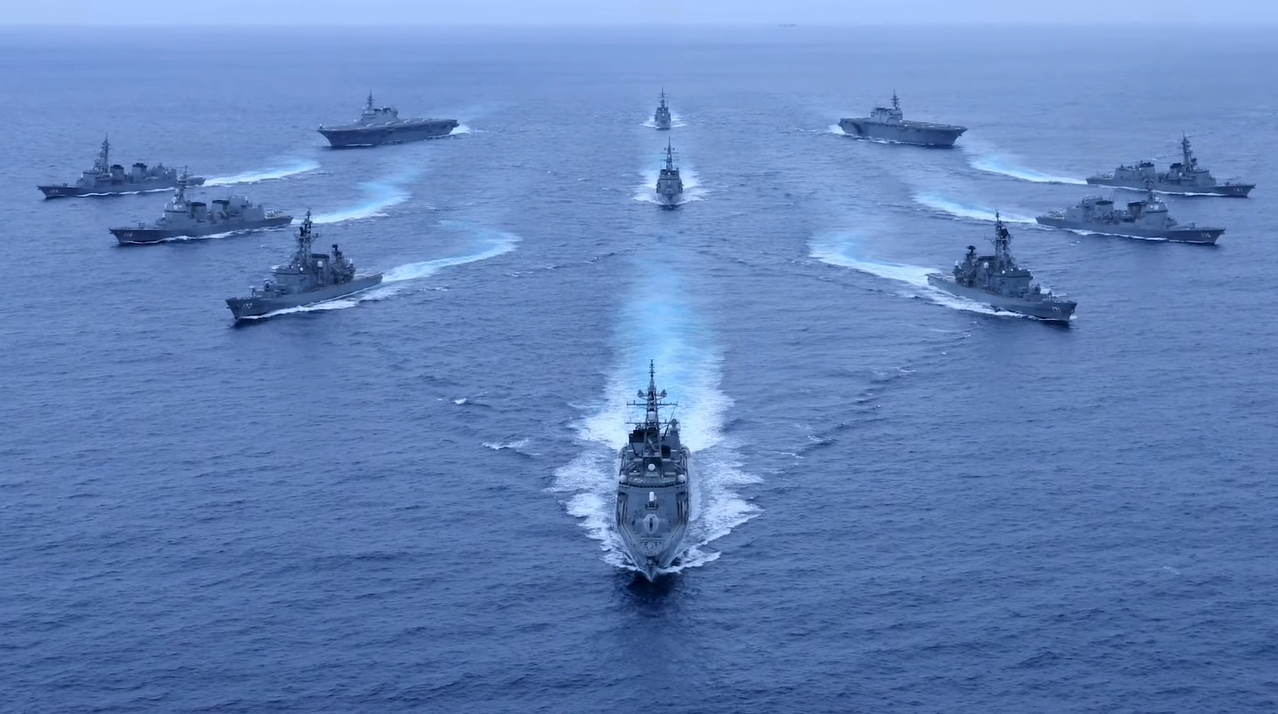
Since 1947, Article 9 of the Japanese Constitution has proclaimed that ‘the Japanese people forever renounce war’. This clause, imposed under American supervision, has transformed the archipelago into an economic giant but a strategic dwarf. In 2025, however, the gap between this pacifism in principle and the security reality has never been more glaring. Faced with an increasingly threatening neighborhood, Tokyo is rearming and testing the limits of its legal framework.
A Hardening Strategic Environment
Three fronts are fueling Tokyo’s nervousness.
First, China is increasing its defense budget, modernizing its navy, and intensifying its incursions around the Senkaku Islands. Second, North Korea has been carrying out numerous ballistic missile launches, several of which have flown over the Sea of Japan. Third, Russia, confronting the West in Ukraine, remains a difficult neighbour, is still at odds with Tokyo over the Kuril Islands.
This simultaneous pressure is forcing the government to abandon its strategic restraint. Prime Minister Abe initiated the shift; his successor Fumio Kishida and Shigeru Ishiba accelerated it. Japan’s defence budget, which was set at 1% of the GDP for a long time has been raised to 2% of the GDP following the Russia-Ukraine war.
Tokyo invested in counter-strike missiles, concluded a reciprocal access pact with the Philippines (June 2025), and launched a joint venture with the United Kingdom and Italy to develop a supersonic next-generation fighter jet.
At the same time, arms export restrictions were loosened, heralding a more active Japan in defense markets.
From Pure Defence to Counter-strike: The Silent Transformation
The shift from pure defence to counter-strike is not new. The Self-Defense Forces (SDF), created in the 1950s, have gradually expanded their scope. The engagements of the SDF include peacekeeping operations in the 1990s, providing logistical support in Iraq and in the Indian Ocean after 2001, and protection of commercial vessels in the Gulf of Aden since 2009.
Since 2022, a milestone has been reached: the new doctrine includes carrying out pre-emptive strikes on the enemy bases.
Prime Minister Ishiba, a supporter of a more assertive Japan, even evokes the birth of an Asian NATO structured around the United States, Australia, India, and the Philippines. Article 9 therefore seems more symbolic than coercive: the country acts like a normal military power, while still waving the flag of pacifism.
The Political Obstacle of Constitutional Revision
Changing the letter of the Constitution, however, remains a perilous exercise. Amending Article 9 requires a two-thirds majority in both houses, followed by a referendum. However, the LDP–Komeitō coalition lacks this two-thirds majority.
Even the public opinion in this regard is split. While 48% of Japanese support the revision, 48% reject it, according to NHK poll of May 2025.
Prime Minister Ishiba is also suffering from declining popularity; inflation and the demographic crisis are eroding household confidence, relegating constitutional reform to a secondary priority.
Scenarios from 2025 to 2030: Progressive Change or Minimalist Revision?
Central scenario: Tokyo continues rearmament without altering the founding text. Alliances strengthen, projection capabilities expand, but the legal umbrella of Article 9 remains. This compromise protects civil society, reassures Western allies, and limits domestic reactions against the return of militarism.
A clear break scenario (unlikely in the medium term): driven by a major external shock – for example, a direct attack – a supermajority emerges to repeal the war renunciation clause. However, domestic obstacles and regional sensitivities make this option remote.
Regional Reactions: Concerns and Convergences
Beijing denounces a return of Japanese militarism and brandishes the memory of the occupation to galvanize public opinion. South Asian countries also tacitly recognize the usefulness of Japan as a counterweight to China. Washington applauds the crossing of the 2% of GDP threshold and the more balanced distribution of the strategic burden.
Between a Pacifist Legacy and Geopolitical Realities
The Japan of 2025 does not renounce its ideal of eternal peace, but it is arming, exporting, and building alliances in a region undergoing rapid change. This ambiguity offers a balance: it reassures part of the population, appeases Western partners, and limits pretexts for diplomatic escalation.
The real question is no longer whether Tokyo will one day abandon Article 9. As long as opinion remains divided and the environment does not degenerate into open conflict, the strategy of gradual circumvention should prevail. Beyond that, the archipelago will have to choose: fully embrace its status as a military power or redefine a new form of credible pacifism in an Indo‑Pacific under high tension.