


All political actions and motives can be reduced to the friend-enemy distinction. This definition is owed to the German jurist Carl Schmitt, a controversial figure among the great names of 20th-century social sciences, who proposed to express, in a concrete and existential sense (in direct opposition to the spiritual-economic dilemma expressed by liberalism), the highest degree of intensity in a bond or a separation, an association or a dissociation.
The enemy does not have to appear aesthetically ugly, morally bad, or be a competitor in the economic sphere. It may even seem advantageous to do business with them. This is of vital importance for our analysis. The enemy is simply the "other," whose mere essence puts our existence at stake.
In the face of the enemy, the possibility of combat always exists. War, then, stems from this enmity, as it constitutes the essential negation of another being. War is thus real enmity in its most manifest form. This need not be a daily occurrence; otherwise, life and progress would be impossible, nor is it necessarily virtuous, morally good, or profitable. Nowadays, it is probably none of those things. Yet the real possibility of it is enough for the concept of the enemy to have meaning.
To the state, as the essential political unit, belongs the jus belli, that is, the real possibility of identifying and, if necessary, combating an enemy by means of an autonomous decision. From the conceptual characteristic of the political arises the pluralism of the universe of states: each state determines its friends and enemies. It makes politics. (Schmitt, The Concept of the Political, 1932.)
Our postmodern and multipolar era differs greatly from the grim world in which Schmitt defined politics. However, the geopolitical order remains an oxymoron.
The BRICS and Kashmir
On April 22, 2025, at 2:40 PM, the beautiful Baistarani Valley, located in the Indian region of Kashmir, wept blood. Twenty-eight tourists were brutally executed by a terrorist group originating from Pakistan. The horrifying scenes captured by survivors drew international media attention. The giant state led by Modi quickly held its neighbours responsible for such actions. India’s response was a tactial bombing of six Pakistani military bases. Clashes between the two nations escalated, ad it is estimated that around 80 peoplewere killed including civilians. In just a matter of hours, the hypothesis of a new nuclear standoff terrified the world and once again pitted India against China’s main regional ally. Could a potential escalation of the Kashmir conflict break the BRICS?
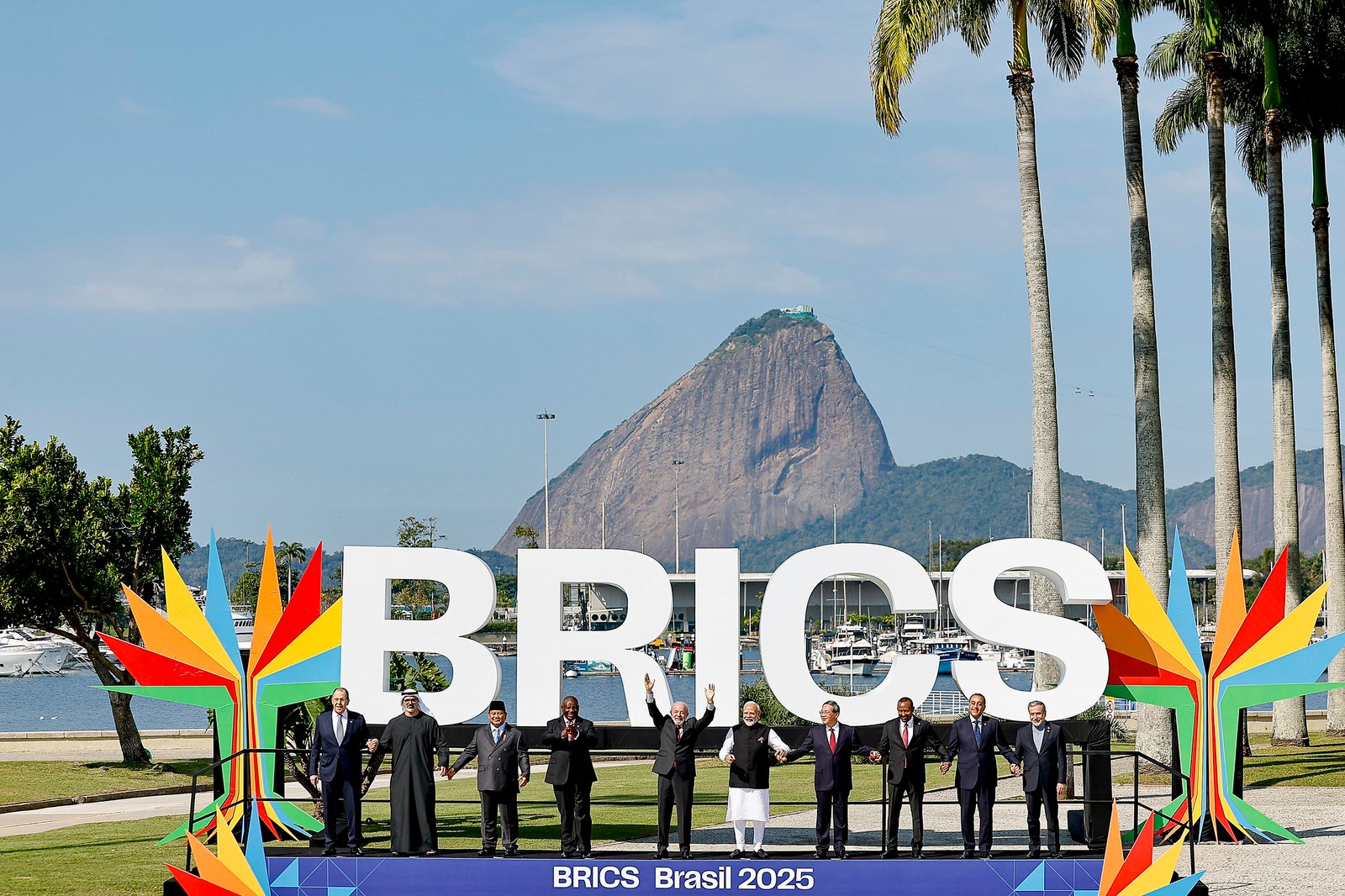
The BRICS+ group represents a strategic and geopolitical alliance among emerging economies, unlike anything seen before in 21st-century rhetoric. One of the key reasons for BRICS+’s growth has been the ability of emerging countries to leverage the new multipolar global order. Their geopolitical reading was spot on.
If anything has become clear, it’s that the “end of history” turned out to be just a breather. The Cold War's polarisation, the fall of the Wall, and America's reign in the 1990s are now museum pieces. Today, the world is a multipolar board game. Where there used to be two players, now it's a poker game with too many aces and no one is willing to show their full hand.
In this scenario, the BRICS have taken on the role of spokesperson for the “Global South” with the boldness of someone who declares themselves host at a party not everyone even knows they’ve been invited to. The term is so broad that it groups everything from emerging powers with ambitions of greatness to countries that, due to historical accidents or colonial legacies, are still fighting to stop being “the others” in the picture of development.
The bloc’s recent expansion with Egypt, Iran, Ethiopia, Saudi Arabia, and the United Arab Emirates joining added muscle. They can now boast of representing nearly half the world’s population and a third of the global GDP. Add to that their control of much of the world’s oil and a significant share of exports, and it becomes serious business. Not just an alliance, but a VIP club with a waiting list and admission rights.
Economically, the BRICS have stopped being the “promising group” and have become a heavyweight rival to the G7 and its traditional institutions like the IMF and World Bank. But while they play as equals in financial terms, one question remains: and politically? Well, that’s another story.
Few analysts consider that between China and India; there is an active conflict hypothesis that indirectly involves Russia. The states that cooperate economically in the bloc are, in Schmidtian terms, political enemies. Blood has already been shed between them on the Kashmir border. Recall the 2020 skirmish between Chinese and Indian soldiers in Ladakh, who, in scenes reminiscent of medieval times, fought to the death using sticks and stones. This resulted in over 20 Indian and 43 Chinese casualties, dead or wounded. Adding to that, China acts as a fervent ally of Pakistan, providing not only diplomatic support but also weapons. It is estimated that 81% of Pakistan’s military acquisitions over the past five years came from China.
Russia, for its part, the other major BRICS+ player, is the main arms supplier to the Indian army. Over the last 20 years, Russia has provided 65% of India’s military equipment. The relationship between the two countries is one of historic friendship. Democratic India always maintained good ties with the USSR (something we cannot say about China) and continues to do so with Putin’s Russia. What we see in this Kashmir escalation is Indian soldiers attacking Pakistanis with Russian weapons, and Pakistani soldiers attacking Indians with Chinese ones.
Conclusion
Schmitt taught that politics, in its purest and most unvarnished form, is not a debating club nor a symposium of good intentions, but rather an arena where the friend-enemy distinction marks the vital rhythm of history (at least to him). The paradox is strikingly droll. In a world that proclaims itself to be more interconnected and plural, the friend-enemy logic not only survives, but it also reinvents itself. States, like old duelists, shake hands in boardrooms and keep watch over each other on the battlefield.