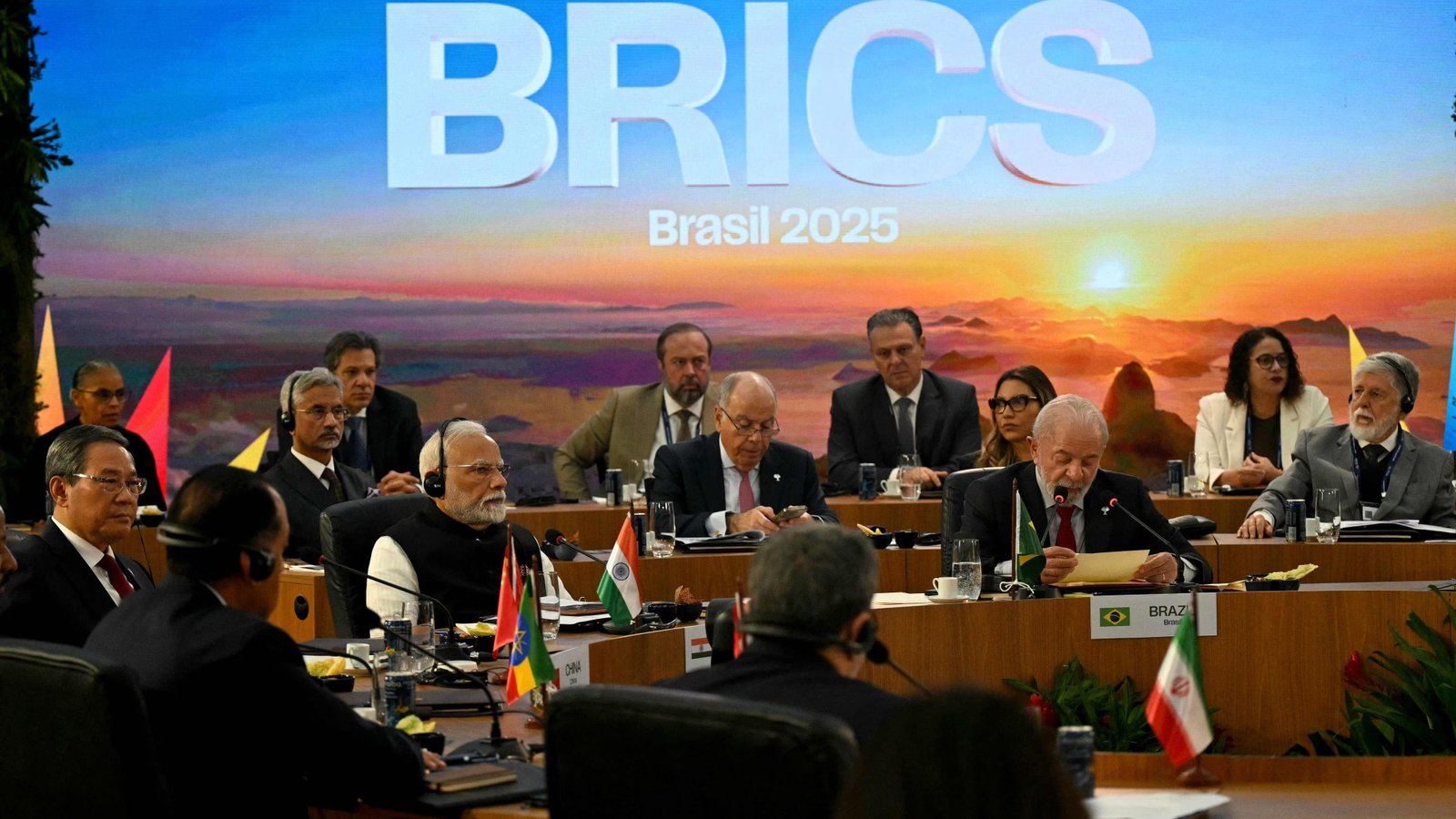
In 2001, a Goldman Sachs Economic Research Report titled, ‘Building Better Global Economic BRICs,’ explored the state of the world economy by emphasizing on the relationship between the G7 countries and the emerging economies of Brazil, Russia, India, and China. A modest group of emerging countries which formally came together in 2010, BRICS has remodelled itself as a revisionist coalition, navigating the ebbs and flows of global politics. Originally a group of five, in recent years, it extended its membership to six new members namely: Egypt, Ethiopia, Indonesia, Iran, Saudi Arabia, and the UAE (The BRICS group: Overview and recent expansion). A European Parliament report argues that this expansion can be perceived as a ‘move to create a more balanced world order’ by promoting and underscoring the ‘perspectives of the Global South and making them more central to global discussions.’ While these countries might have diverse interests, the shared values that bind them together is the emphasis on multilateralism and global governance and financial institutions reforms.
Consequently, the agenda of the bloc has diversified towards integrating non-traditional security (NTS) concerns. These issues include climate change, hunger, poverty, artificial intelligence, women and human security. These threats, while not military or traditionalist in approach, pose a risk to the development and security of the Global South. To navigate the evolution of BRICS’ engagement with these challenges, this article studies the shift in the prioritisation of NTS between the 2024 Kazan Declaration and the 2025 Rio de Janeiro Declaration. By conducting a comparative content analysis, the article focuses on – in what capacity has NTS been incorporated into the BRICS agenda, and what might account for this shift?
Critical Security and NTS: Conceptual Framework from the Global South
Traditionally, security studies have been defined, conceptualized, and theorized from the perspective of a Eurocentric approach, primarily focusing on the state’s ability to counter external threats (Upadhyaya, 2004). This approach was rooted in the realist tradition of security studies that dominated the domain of International Relations throughout the dominant years of the Cold War. This was challenged by the intervention and contribution of the critical studies movement in the 1980s. The narrow definition of security moved towards a broader and wider approach. Buzan et al. posited literature on sectors beyond military (broadening) and surpassing the state as the sole referent objects in security.
While Buzan et al. broadened the theoretical scope, critiques from the Global South interrogated the Eurocentric biases. Barkawi, for instance, critiques the ‘Eurocentricism’ of security studies, maintaining how the conflicts and struggles during the Cold War were perceived in terms of the ideological rivalry between the East and the West. In a similar vein, Acharya emphasizes that insecurity for the Global South is tied to non-traditional threats such as ‘poverty,’ ‘underdevelopment,’ ‘environmental degradation,’ etc.
Other critical traditions have broadened the referent object of security beyond the state. Feminist approaches have produced literature on the roles of women in development and security (de Jonge Oudraat & Brown, 2020), while the securitization of environment and climate change highlights the vulnerabilities of ecosystems and individuals (H.G Brauch, 2009). The UNDP’s Human Development Report (1994) marks a shift by placing the individual at the locus of the security discourse.
Building upon these conceptual frameworks, this article adopts a NTS lens. Rooted in the epistemologies of the Global South and alternate understanding of security, the study analyses how BRICS- a block standing for much of the Global South- has begun to address these alternative insecurities, and a move from state-centric to other levels of analysis.
Methodology: Comparative Content Analysis and Thematic Coding
The article conducted a comparative content analysis of two primary sources: BRICS Leaders’ Declaration from 2024 (Kazan) and 2025 (Rio de Janeiro) which together formed the corpus of this article. It aimed to study the role of the bloc in engagement with non-traditional security (NTS). The unit of analysis defined for the article were the paragraphs, which were pre-numbered in the reports. The study focussed on a deductive coding scheme, based on the following NTS themes:
● AI & Digital Security: Includes references to artificial intelligence, digital governance, ICT frameworks, cyber-security, data regulation, and emerging technologies (like quantum computing).
● Environmental Security: Includes mentions of climate change, environmental degradation, energy security, water security, biodiversity, COPs, and sustainability.
● Gendered Security: Includes mentions of gender-responsive governance and women’s participation/ empowerment in economy, politics, and security.
● Global Health & Food Security: Includes mentions of healthcare, post-pandemic prevention and cooperation, vaccine diplomacy, food insecurity, agricultural resilience, etc.
● Human Security: Includes references to human rights, working conditions, socioeconomic protections, and individual freedoms.
To operationalize the coding process, the research pursued keyword scan and text mining with Voyant Tools. The tool performed preliminary keyword scan and frequency analysis across the two sources. Baguette enables paragraph-level qualitative coding. Multi coding was employed when the themes overlapped. The resulting codes were structured into a frequency matrix and grouped bar graph using Tableau, which enabled comparison of the two sources. An analysis was conducted by comparing frequency, analysis of the thematic depth of each NTS category, and identifying new non-traditional security sectors introduced in 2025.
Finding and Analysis
This section delves into a comparative content analysis of the Kazan (2024) and the Rio (2025) BRICS Leaders’ Declarations. It examined how the bloc has reoriented its priorities towards five key NTS themes. Through paragraph-level coding, the analysis captures how often these themes appear in both the declarations.
Frequency and Diversity of NTS References
The frequency matrix below (along with the graph) illustrates the distribution of NTS themes across the 2024 and 2025 BRICS Declarations.
Table 1: Frequency of NTS Mentions in BRICS Declarations (2024-2025)

Source: Author’s own compilation
Figure 1: Comparative Distribution of the themes in BRICS Declarations (2024-2025)
Source: Visualised in Tableau
The data above shows a consistent expansion of BRICS’ security discourse. Engagement and discussions on AI and digital security saw an upward trend of 120%, alongside other themes which showed statistically significant increase. The frequency shifts are not only numerical, but also signal a transformation and diversification in BRICS’ security agenda.
Thematic Comparison: From Kazan to Rio
The thematic domain of AI and digitisation witnessed the sharpest evolution from 2024 to 2025. While the Kazan declaration called for cyber cooperation and digitisation of sectors, the Rio declaration introduced the BRICS Leaders’ Statement on the Global Governance of Artificial Intelligence (paragraph 16). This approach aimed to responsibly develop, deploy, and use AI technologies for ‘sustainable development and inclusive growth.’ The 2025 declaration additionally embraces the UN Cybercrime Convention (paragraph 41) and proposes the establishment of a permanent UN-led mechanism for ICT security. This positions BRICS more than a digital rights stakeholder, transitioning it into an active norm setter in AI governance. On the environment front, the recent declaration introduced the bloc’s framework on Climate Finance (paragraph 83). The framework emphasizes equitable and affordable financing as an essential criteria for developing countries to pursue ‘just transition pathways’ mentioned under the United Nations Framework Convention on Climate Change (UNFCCC) and Paris Agreement. While both the declarations address land degradation, biodiversity, and river systems, the Rio declaration additionally offers policy directions on climate-resilient and water security strategies.
Gendered security is thematically present in both declarations but the Rio declaration lays emphasis on the Women Peace, and Security (WPS) agenda (paragraph 20), marking the 20th anniversary of the UNSC Resolution 1325 highlighting the same. Global health and food security, on the contrary, displays a deeper engagement in the 2025 declaration as it launches the BRICS Partnership for the Elimination of Socially Determined Diseases (paragraph 107). The declaration underlines the bloc's commitment to ‘advancing health equity’ alongside addressing the causes of health disparities in the developing world. Finally, the human security domain reflects both continuity and innovation. In the recent declaration, it articulates increasing willingness to a rights based and freedom-oriented vision of global governance embedded in the human security paradigm.
Drivers Behind BRICS’ Changing Security Concerns
Pivoting of BRICS towards non-traditional security sectors is shaped by various factors including the expansion of membership, reputational politics, post-pandemic policy alterations, and a stronger narrative of South-South solidarity. Together, these underlying themes reflect the bloc’s understanding of security, which drifts away from hard, traditional security towards a holistic and developmental understanding of security.
The first major cause of pivoting towards NTS is the expansion of the membership. It reached ten this year, including Indonesia as the latest member and Nigeria as a partner (Friedrich Naumann Foundation, 2025). According to the PIR Center, the security agenda for BRICS has evolved over the years particularly because of the attitudes and considerations of the member states towards emerging issues and opportunities. For instance, TV BRICS noted that the group had significant potential in food production and supply. They further write that in 2024, a working group on agriculture formulated priorities highlighting food security, developing mutual trade, and ensuring sustainable agricultural production.
Second, BRICS’ embrace of NTS is also driven by the blocs desire to challenge the status quo and promote multi-polarity. World Politics Review argues that since its outset, the bloc has stood to reform international institutions, particularly the World Bank and the IMF, to better meet the needs of developing countries. BRICS has been successful in launching its frameworks on contemporary issues such as AI governance and climate finance, as discussed in the 2025 Declaration, where the West is yet to establish normative consensus.
During the pandemic, Brazil, India, and Russia were ‘three of the top five countries with the highest disease burden’ (InfoBRICS.org). The legacy of the pandemic continues to shape non-traditional security within BRICS, keeping global health security in primacy to its policy considerations. Alongside, the organisation has been actively involved in implementing the WHO Pandemic Agreement which aims to strengthen cooperation in the ‘prevention, preparedness, and response’ to pandemic. Synchronously, the commitment to address health and disease insecurity is in line with the Sustainable Development Goal 3 – Good Health and Well-being (BRICS Brazil).
Lastly, the theme undertaken in the 2025 Summit – “Strengthening Global South Cooperation for a More Inclusive and Sustainable Governance” – highlights the bloc pivoting towards a narrative rooted in Southern solidarity. Despite the member states having divergences on various issues, an article on the official portal of BRICS notes that bloc has demonstrated ‘the ability to converge on key agendas,’ including ‘defending multilateralism, dialogue, and strengthening the voice of the Global South.’
Implications and Conclusion
The comparative analysis of the two primary sources reflects depth and transformation in the bloc's engagement with NTS. The Rio Declaration not only expands on the frequency of mentions, but also delves into its institutional articulation. The introduction of the Climate Finance Framework, Global AI Governance Statement, and the Partnership for the Elimination of Socially Determined Diseases signifies a move committed to policy formulation. These shifts depict BRICS proactive engagement in the global forum, shaping normative agendas particularly on AI. The success, however, depends on the bloc's ability to implement and institutionalise the declarations.
In closing, BRICS’ growing engagement with non-traditional security depicts South-South solidarity, anchored around the shared insecurities of the Global South. It offers an alternative to the western-led frameworks on climate, sustainability, AI, and energy. The recent inclusion of emerging regional powers from Africa, Asia, and Latin America displays the bloc’s representational outreach. By underscoring multi-polarity and alternative frameworks, BRICS positions itself not only as a revisionist bloc, but also as an aspiring norm setter. In doing so, it reinforces the narratives and visions of the Global South.