


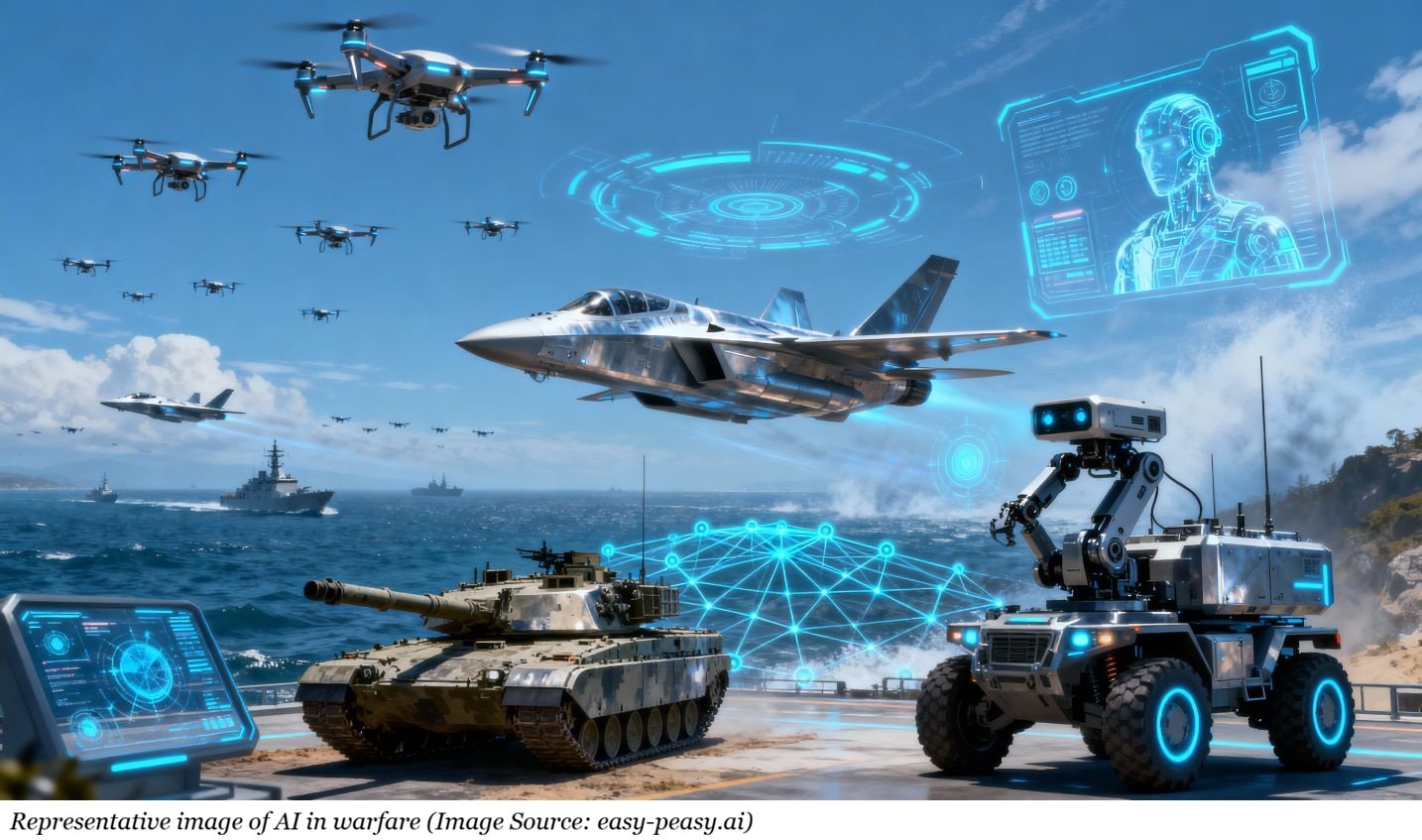
Artificial Intelligence (AI) is changing the face of war, international relations, and the market of military equipment. It is seen as a transformation that is not just technical, as it affects strategy, poses ethical and legal challenges, and brings huge questions of arms races of a new kind.
Uses of AI in the Battlefield
Perception and Targeting
AI systems analyse cameras, sensor, and satellite feeds to detect and engage targets quicker than the human eye can react to visual input. This capability fuels the development and use of smarter drones and “loitering munitions”, which have the capacity to search for and engage their targets while they are still airborne. The use of such munitions has been noted in recent conflicts.
Automated Decision Research
Autonomy and persistence. Some systems survive the journey even if communications fail, enabling actions to be taken during times of poor communication. Military forces claim successful deployment of drone squadrons that use AI to locate and persist on targets autonomously Reuters, Decision support and logistics. This technology aids the commander to sift through large amounts of data quickly and make informed decisions in real time.”
Real-world Examples
Ukraine: In the Russia-Ukraine war (going on since February 2022) the two forces have employed drones, image recognition software, and AI targeting in their warfare. Thus, the Ukrainian forces have leveraged the power of volunteers, as well as available technologies, to enhance their efficiency in using drones to attack logistics, air defence, and supply chains. The impact is seen on the front-line battlefield.
Russia: Russia has possessed loitering munitions (for example, the Shahed series of UAVs); in addition, Russia has publicly discussed scaling up AI-aided UAV units and production. This reflects a concern for how inexpensive unmanned or semi-unmanned UAVs can function.
Global Suppliers and Firms
Startups and defence procurement are increasingly investing in AI-based sensors, autonomy, and associated data systems, thus fuelling the growth of AI-related technologies, which are trickling down from commercial to military supply chains. Lately, reports from the sector have noted the rapid rise of investment in military tech and solutions for the battlefield.
How AI’s battlefield Use is Changing the Strategic Environment?
Lowered Cost of Lethality and Escalation
The low cost of AI-based systems, such as small drones and “loitering” munitions, can create an environment conducive to crisis instability as small attacks can escalate quickly, especially if reactions are misinterpreted.
Diffusion and Proliferation
While not as big a problem for nuclear weapons or advanced fighter jets as proliferation is, the fact that many AI systems utilize commercial components and software, which are easy to spread, still makes proliferation difficult to control through conventional means.
Arms Race Dynamics and Strategic Imbalance
States that are adept in the field of military AI are likely to have the upper hand in matters such as scouting, speed, and accuracy. This will, in turn, lead to a form of arms races, particularly for opponents, as they will be forced to increase their defence spending and upgrade their cybersecurity.
Diplomatic and Legal Friction
There is a move by various countries and NGOs to establish new international regulations on issues pertaining to autonomy in lethal systems, human control, transparency, and accountability. However, consensus on this issue is a challenge, particularly when major countries are opposed.
Policy Options and Practical Steps
Invest in Defensive AI and Resiliency
States should have an artificial intelligence strategy that leans towards defence, such as counter-drones, cyber, and electronic warfare, rather than offense, because of the pace at which they will continue to lag behind.
Common Standards and Verification
Consistently, greater international agreements might start first with those measures that would build trust. It is about transparency measures, safety testing standards, and limits on fully autonomous lethal action.
Export Controls Tailored to Software
Controls should take into account the role of data and software in AI capability – not only hardware.
Civilian-Military Cooperation
Democracies need to coordinate industry safety standards, ethical design and procurement rules to ensure civilian oversight.
Human-in-the-loop Requirements
This means that governments should ensure that all critical military decisions supported by AI retain the element of meaningful human judgment, thereby limiting the possibilities for accidental escalation, misidentification of targets, and ethical outcomes resulting from algorithmic failures.
AI Accountability and Audit Mechanisms
There is a need for regular audits of military AI systems by states with respect to reliability, bias checks, and adherence to international humanitarian law. Clear responsibility needs to be fixed so that misuse or malfunction does not escape legal scrutiny.
Conclusion
AI is not a single weapon but a multiplier; it amplifies reconnaissance, hastens the speed of decisions, and extends the destructive power of relatively inexpensive systems. That cocktail is rewriting strategy, accelerating defence spending, and creating diplomatic headaches. Practical steps-from investments in defence to negotiating norms on transparency-can reduce the worst risks. But the economic incentives are strong: billions of dollars in market growth, combined with rising defence budgets, make AI a structural feature of modern warfare, not some passing trend.