


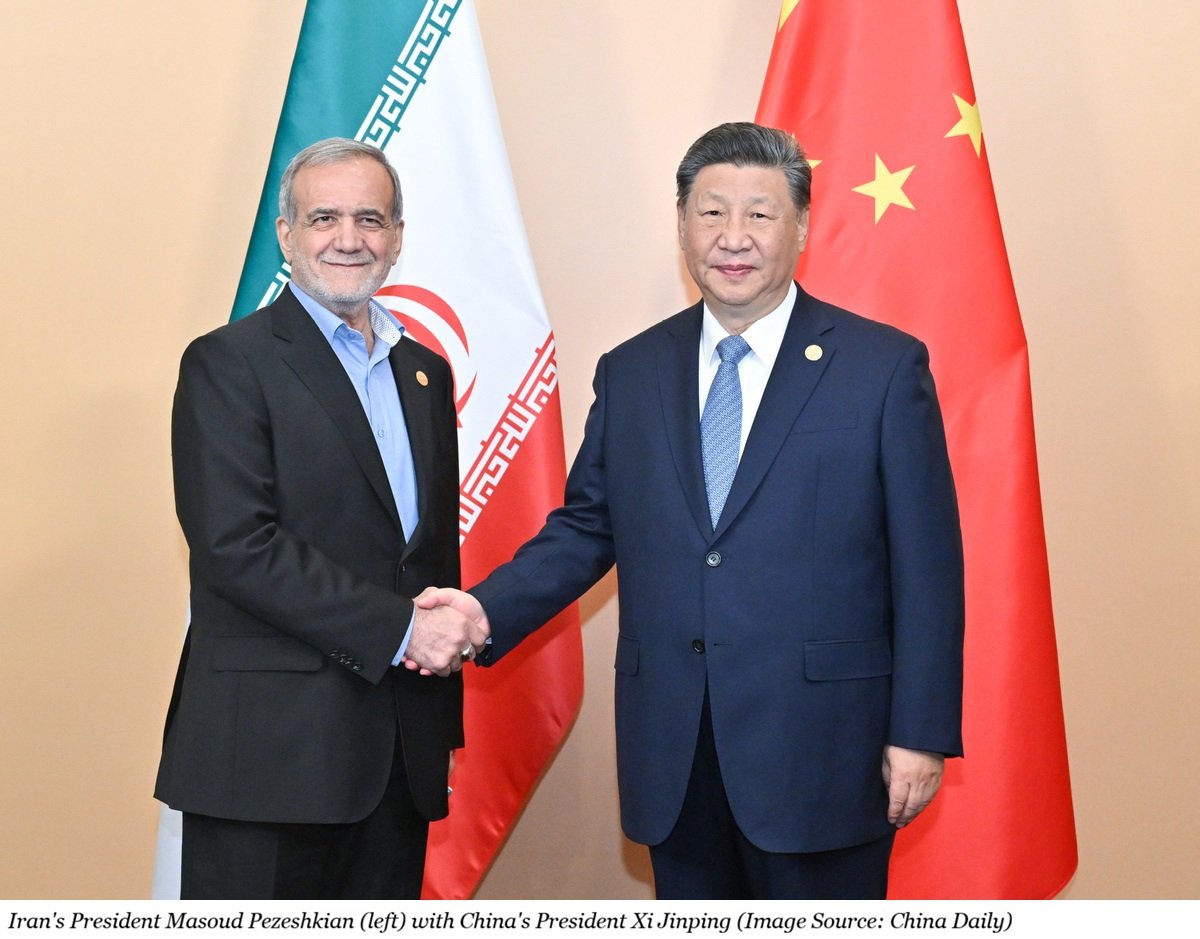
At first glance, the war by the United States (US) against the Iranian mullahs seems to follow a strictly Middle Eastern logic: weakening a hostile regional power, damaging its military structure, protecting Washington’s allies, and restoring deterrence. But this reading, while partly true, is incomplete. Behind the visible clash between Washington and Tehran, a broader fault line is emerging: the growing rivalry between the US and China. Iran is not only an enemy of the US; it is also one of China’s important energy and geopolitical partners. So hitting Iran also means putting indirect pressure on Beijing.
Still, one must avoid oversimplifying the issue. To speak of a total American “strangling” plan against China would go too far. But to speak of a strategy of gradual energy pressure on Beijing is much more credible. The numbers are telling. In 2025, China imported around 1.38 million barrels a day of Iranian oil. That represented more than 80 percent of Iran’s seaborne oil exports and about 13.4 percent of China’s seaborne crude imports. This is not a marginal flow. It is an important source of supply, especially because Iranian oil, under sanctions, is often sold at discounted prices. That makes it highly attractive for China’s independent refiners. If this channel were reduced or cut, China’s economy would not collapse overnight, but its energy costs would rise and one of its useful margins of maneuver would shrink.
The same logic applies to Venezuela. Here too, the issue is not only Latin American. After Washington reasserted control over the Venezuelan file, oil exports to Asia, especially to China, fell sharply in February 2026 to around 48,000 barrels a day, far below previous levels. At the same time, more of these flows were redirected toward the US and Europe under American supervision or approval. In other words, two useful suppliers for Beijing, one in the Middle East and one in the Western Hemisphere, are being weakened almost at the same time. From Beijing’s point of view, this convergence cannot be seen as meaningless.
But the real lever may not even be Iran itself. The real lever is the geography of energy. China gets about half of its oil from the Middle East, and the Strait of Hormuz remains one of the most sensitive chokepoints in the global system. More than 20 million barrels a day pass through it, making it one of the most strategic maritime passages in the world. China alone accounts for a very large share of the oil imports transiting through this route. The recent events have once again shown how decisive this chokepoint is. Any prolonged destabilization in the Gulf automatically increases China’s energy vulnerability, even if Beijing is not directly targeted.
This is where the real strategic picture appears. The main theatre of the US-China rivalry remains the Indo-Pacific, technology, maritime power, supply chains, semiconductors, and regional military balance. American strategic documents say this clearly: Washington’s main priority is to deter China in the Indo-Pacific. That means the Middle East is not the only center of the confrontation, but it can become a crucial secondary front. By weakening Iran, reshaping Venezuela, controlling sea routes, and influencing global oil prices, Washington does not necessarily strangle Beijing. But it does raise its strategic costs. And in a long-term rivalry, raising the cost for your rival is already a partial victory.
Of course, China is not defenseless. It has significant reserves, logistical flexibility, growing access to Russian crude, and an active diplomacy with Gulf monarchies. China can absorb a shock. That is why the idea of a rapid strangulation is exaggerated. But the idea of a progressive tightening of China’s energy space is serious. China can adapt, but it cannot ignore forever the loss of several cheap suppliers and the vulnerability of its maritime routes.
The real geopolitical reading is therefore the following: the war against the mullahs is not only about Tehran. It is also part of a broader reshaping of the global energy and strategic order. The main conflict between the US and China is not fought only over Taiwan or semiconductors. It is also fought through straits, tankers, sanctions, discounted oil, and invisible dependencies. Iran, in that sense, is not the only center of the US-China rivalry. But it may well be one of its clearest and harshest revelations.
(Gilles Touboul is a geopolitical analyst and former international currency trader with expertise in Middle East and Asia)