


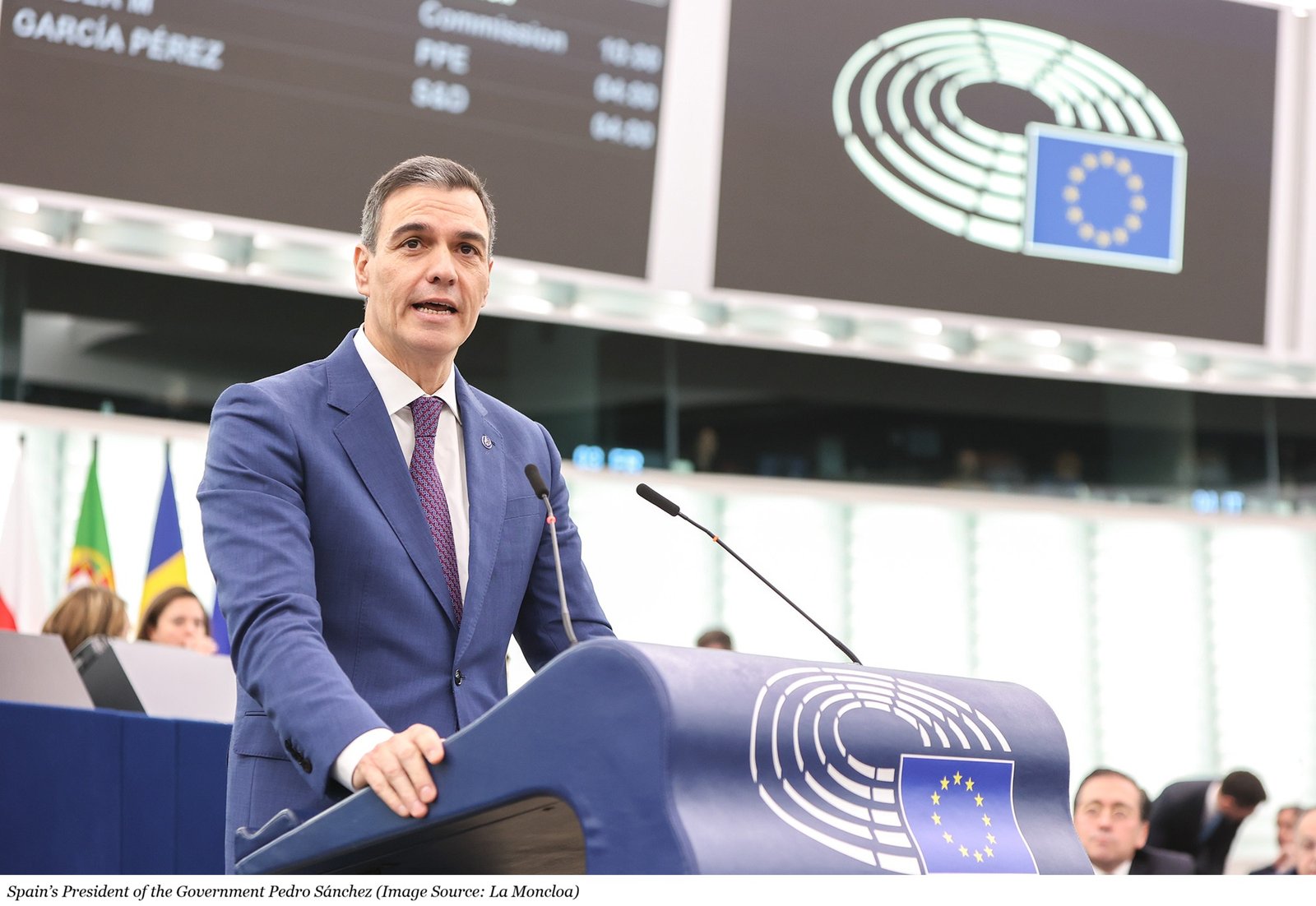
At the time when the United States’s (US) and Israel’s war against Iran is raging on; there appears to be some resistance to this action from the US’s own allies. The most significant resistance to the US came from its own ally and a NATO member – Spain.
Spain’s President of the Government Pedro Sánchez has criticized the action by the US and Israel against Iran. While condemning the human rights abuses carried out by the Iranian regime, Sánchez unequivocally stated that the recent military actions are contrary to international law.
Spain’s Foreign Minister José Manuel Albares confirmed that his government has not allowed the US to use the Rota Naval Station and Morón Air Base, military facilities jointly operated by Spain and the US. Further, Spain has removed its ambassador from Israel in protest of Israel’s action against Iran. Under Sánchez, Spain has positioned itself as one of the most vocal critics of Israel.
In retaliation to Spain’s refusal to allow the use of the military bases, the US has threatened to cut all trade with Spain. However, this may be easier said than done. The US trades with Spain through the European Union (EU). Under the legal structure of the EU, there is a customs union and a Single Market. It implies that trade of the EU members is regulated within a common framework that deals with customs, taxes and tariffs. So, it would not be easy for the US to isolate Spain.
Spain’s assertive stand on the war in Iran has caused a rift between Madrid and Washington. Interestingly, Spain’s ties with the US were developed around military cooperation. Following Francisco Franco’s ascension to power in 1939, Spain faced international isolation as no country wanted to be associated with Spain led by Franco whose regime was considered to be dictatorial. It was only in 1953, through Pact of Madrid, when Washington reached out to Madrid since the former believed that the latter could be a formidable ally against the socialist USSR. The Spain-US partnership warmed up with the US providing economic assistance to Spain. In return, Spain allowed the US to set up military bases on the Spanish territory. However, the overall profile of the Spain-US relations has remained low in the past more than seven decades.
Sánchez’s stand on the war in the Middle East may be conveniently considered as growing fault lines with the NATO allies. However, this stand needs to be understood from Spain’s foreign policy point of view. The posturing by Sánchez points towards a mixture of ideological leanings as well as some futuristic outlook.
First, the ideological factor. Sánchez’s party, the Spanish Socialist Workers’ Party, a leftist party, has had traditionally uncomfortable relations with the US. Contrary to this, the Popular Party, a right-wing party which is currently in the opposition, has always enjoyed warm ties with the US. A case in point here is the approaches of the two former presidents of the government of Spain. José Luis Rodríguez Zapatero of Spanish Socialist Workers’ Party, who was the president of the government from 2004 to 2011, never visited the US. On the other hand, José María Aznar of Popular Party, travelled to the US 16 times during his eight-year term as the president of the government from 1996 to 2004. Further, Aznar had supported the US’s war against Iraq in 2003. Sánchez’s approach to the current war in Iran partially stems from the ideological base of his party.
Second, by refusing to participate in the war or even refusing to assist Washington, Madrid is taking a stand in the debate on European security that is going on for a long time. In the recent years, particularly during Donald Trump’s both the terms as the US president, the ties between US and its European allies have experienced friction. There is an exacerbation in the sentiment, in the European capitals, that Europe should no longer be the theatre of war or an instrument for the US for its own hegemonic goals. For his part, Sánchez has advocated creation of a European army to reduce Europe’s dependence on the US for security.
Third, while the US’s and Israel’s war against Iran is having a destabilizing effect worldwide, Asia in particular is facing the worst consequences of this war. Sánchez’s stand against the US is a result of Spain’s attempts towards increasing engagements with Asia. For decades, Spain’s foreign policy was primarily focused on Europe, Africa and Latin America. Since the last about two and a half decades, Madrid has been making concerted efforts to diversify its external engagements. In this regard, the Asia-Pacific Region has received special attention from the Spanish political dispensation. A stable Asia is in Spain’s interest as Madrid is now looking to expand its engagements across the continent, right from India in South Asia to China in East Asia and Vietnam in Southeast Asia. The continuing war in Iran is not only disrupting the economic activities within Asia; it is also causing unnecessary delays and stoppages in Asia’s economic engagements outside of the continent. So, while Spain has economic stakes in the US, growing economic and strategic engagements with Asian powers is pushing Madrid to take a stand in protecting its own interests in the Asia-Pacific, the economic epicentre of the world.
Fourth, Spain is a strong advocate of a multilateral and rules-based order. In recent years, Spain’s foreign policy has advocated multilateralism and strong international institutional mechanism. Refusal to toe the US’s line is a part of Spain’s endeavour to pursue its foreign policy goals and to resist the global polarization through uni-polar or bi-polar world order.
This may be too early to say. However, Spain has always given the impression of a country that punches way below its potential in the international affairs. Spain, despite being the second-largest country in the European Union in terms of size and currently one of the fastest growing European economies, has maintained a benign and somewhat a reserved profile in terms of participation in the international order. However, with its assertive stand on the war in Iran, Spain seems to be looking to play a more proactive role in the global affairs.
(Niranjan Marjani is the Editor-in-Chief of Global Horizons. Follow him on @NiranjanMarjani)