


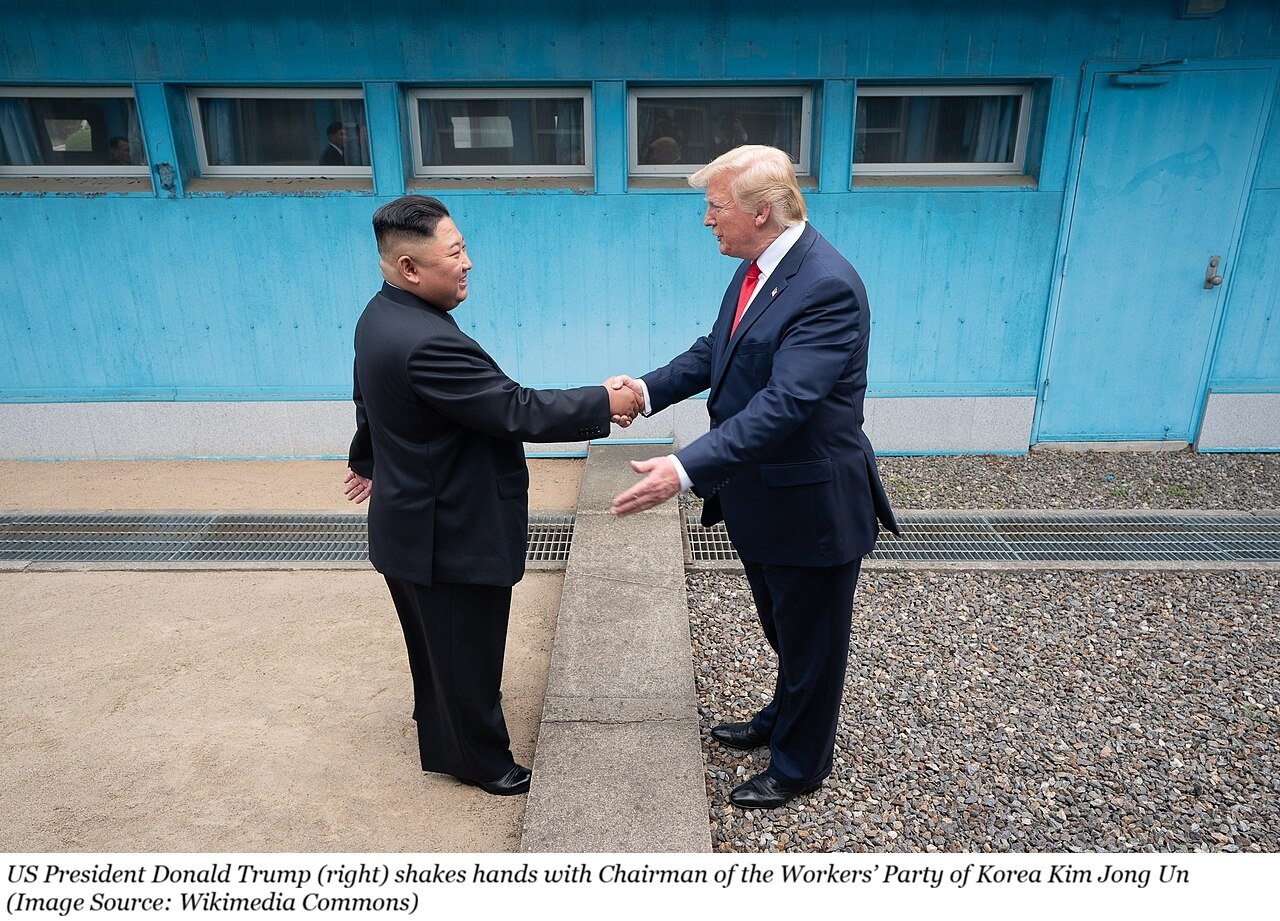
Donald Trump’s return to the White House in January 2025 immediately revived an old diplomatic illusion: the idea that he could do with Kim Jong-un what no American president had managed before him — strike a historic, personal, spectacular deal.
The fantasy is familiar. Donald Trump believes that what institutions fail to produce, men of will can impose. In his world, diplomacy is not a slow collective mechanism built on procedure, sequencing, and verification. It is a test of personal chemistry, pressure, and theatrical leverage. He does not instinctively think like a strategist of institutions. He thinks like a negotiator of force.
That is precisely why the North Korean file keeps returning to him in the same form. The proposition looks simple on paper: North Korea would accept a gradual form of denuclearization in exchange for security guarantees, sanctions relief, and political recognition. But that formula has already been tested. Singapore in 2018 produced images, symbolism, and headlines. Hanoi in 2019 exposed the substance: Washington and Pyongyang were not negotiating the same thing.
The Americans wanted a dismantling process. The North Koreans wanted a redefinition of the relationship on terms that would preserve the regime and protect its strategic assets. The meeting collapsed because the gap was not tactical. It was structural.
Yet the idea survives, because Trump’s political instinct is deeply vulnerable to the logic of the “big deal.” He is naturally drawn to files where he can imagine himself breaking through decades of stalemate by force of personality alone. Kim Jong-un understood that faster than most. By building a personal channel with Trump, he found a way to partially escape the old multilateral architecture, its constraints, and its costs.
And that is where the problem begins for Seoul.
Seoul: Indispensable, Yet Always at Risk of Exclusion
The weakness of South Korea’s position is not accidental. It is built into the diplomatic geometry of the peninsula.
Seoul is the actor most directly exposed to every evolution of the North Korean question. It would be the first to pay the price of war, the first affected by instability, the first concerned by any durable political change in the North. And yet it is also the actor most likely to be pushed to the side when Washington and Pyongyang decide to deal directly with one another.
That is the paradox of the peninsula: the country with the most at stake is not always the country sitting at the center of the negotiation.
Under Trump, this risk becomes sharper. His conception of alliances has always been less strategic than transactional. He does not first ask what South Korea represents in the broader balance of power in Asia. He asks how much it costs, who is paying, and whether the arrangement still looks profitable to the United States. The 28,500 American troops stationed in South Korea are, in a classical strategic reading, much more than a military deployment. They are a deterrent signal, a regional anchor, and a message addressed not only to Pyongyang, but also to Beijing.
Trump has often seemed less interested in that architecture than in the financial ledger behind it.
That matters enormously. Because once an alliance is reduced to a protection contract, its political depth begins to erode. The ally is no longer treated as a strategic partner, but as a client. And once that shift happens, the possibility of negotiating over its head becomes much easier to justify.
That is the real South Korean fear. Not simply that Washington talks to Pyongyang, but that it does so in a way that treats Seoul as an interested spectator rather than a co-author of the outcome. In that configuration, the alliance does not disappear formally. It becomes something thinner, more conditional, more revocable.
In other words, less an alliance than an option.
Kim Jong-un’s Real Objective: Not Peace, But Recognition
One of the recurring mistakes in Western analysis is to treat North Korea as if it were still, at heart, negotiating the terms of its denuclearization. It is not.
Kim Jong-un learned the core lesson of the last decade: his nuclear capability is not a bargaining chip to be surrendered at the end of a process. It is the regime’s insurance policy. It is the ultimate guarantee of survival, the tool that protects the state from external coercion, and the instrument through which Pyongyang forces the world to deal with it as more than an isolated dictatorship.
The true North Korean objective is not to trade away the bomb. It is to normalize the fact of its possession without formally saying so.
This is why Pyongyang’s strategy is based on controlled asymmetry. It alternates provocation and restraint. It raises pressure through missile tests, military signaling, and controlled escalation, then reopens limited diplomatic space to avoid uncontrolled crisis. The pattern seen in recent years is not erratic. It is calibrated. North Korea does not seek chaos for its own sake. It seeks recognition without surrender.
From that perspective, a new Trump-Kim summit would be a geopolitical gift to Pyongyang unless Washington extracted something concrete and verifiable beforehand — which remains highly unlikely.
The summit image itself would already be a strategic gain for Kim. It would reaffirm what he wants the world to accept: that North Korea is not a pariah begging for relief, but a nuclear power whose leader deserves direct engagement from the president of the United States.
That would not mean Pyongyang had won everything. But it would mean it had advanced on the most important front: legitimacy.
China, the Silent Regulator of the Peninsula
No serious reading of the Korean question can ignore the Chinese variable. Beijing may not always be the loudest actor in this theater, but it remains the indispensable one.
China’s interest is not in solving the North Korean problem once and for all. Its interest is in preventing the problem from producing an outcome contrary to its own security calculus. A collapsed North Korea would create instability on China’s border, possible refugee flows, and the risk of a reunified peninsula aligned militarily with the United States. A fully pacified and strategically realigned Korea would be no less problematic from Beijing’s point of view if it reduced China’s buffer space.
For Beijing, the ideal situation is therefore not peace in the absolute sense. It is controlled tension. A North Korea stable enough not to implode, but troublesome enough to remain a permanent complication for Washington and its regional allies.
That makes China the silent arbiter of the peninsula. Not because it dictates every move Pyongyang makes, but because it defines the outer limits of what remains geopolitically tolerable.
Any American administration that imagines it can redesign the Korean balance without taking Chinese interests into account is indulging in fiction. And Trump, precisely because his relationship with Beijing remains shaped by confrontation, tariffs, and strategic rivalry, has limited capacity to secure the tacit Chinese cooperation that any durable arrangement would require.
China has no real reason to surrender one of its most useful regional levers.
Conclusion: The Peninsula Cannot be Solved Through Summit Diplomacy Alone
The Korean peninsula is one of those places where geopolitical reality resists political theater.
Trump may still be tempted by the image of the statesman who succeeds where others failed. Kim will remain tempted by the diplomatic and symbolic benefits of direct presidential engagement. China will continue to prefer a controlled freeze to any true strategic transformation. And Seoul will remain exposed to the most dangerous contradiction of all: being central to the problem, yet vulnerable to exclusion from its supposed solution.
That is why the issue is not simply whether another Trump-Kim summit happens. The deeper issue is whether South Korea can continue to entrust the core of its strategic future to an alliance whose political reliability may fluctuate with the instincts of one man in Washington.
For Seoul, this is no longer an abstract doctrinal debate. It is a geopolitical imperative. Strategic autonomy does not mean abandoning the American alliance. It means reducing the risk of being trapped by it. Middle powers are respected only when they create their own weight. Otherwise, they are spoken about, negotiated over, and occasionally protected — but never truly in command of their own destiny.
(Gilles Touboul is a geopolitical analyst and former international currency trader with expertise in Middle East and Asia)