


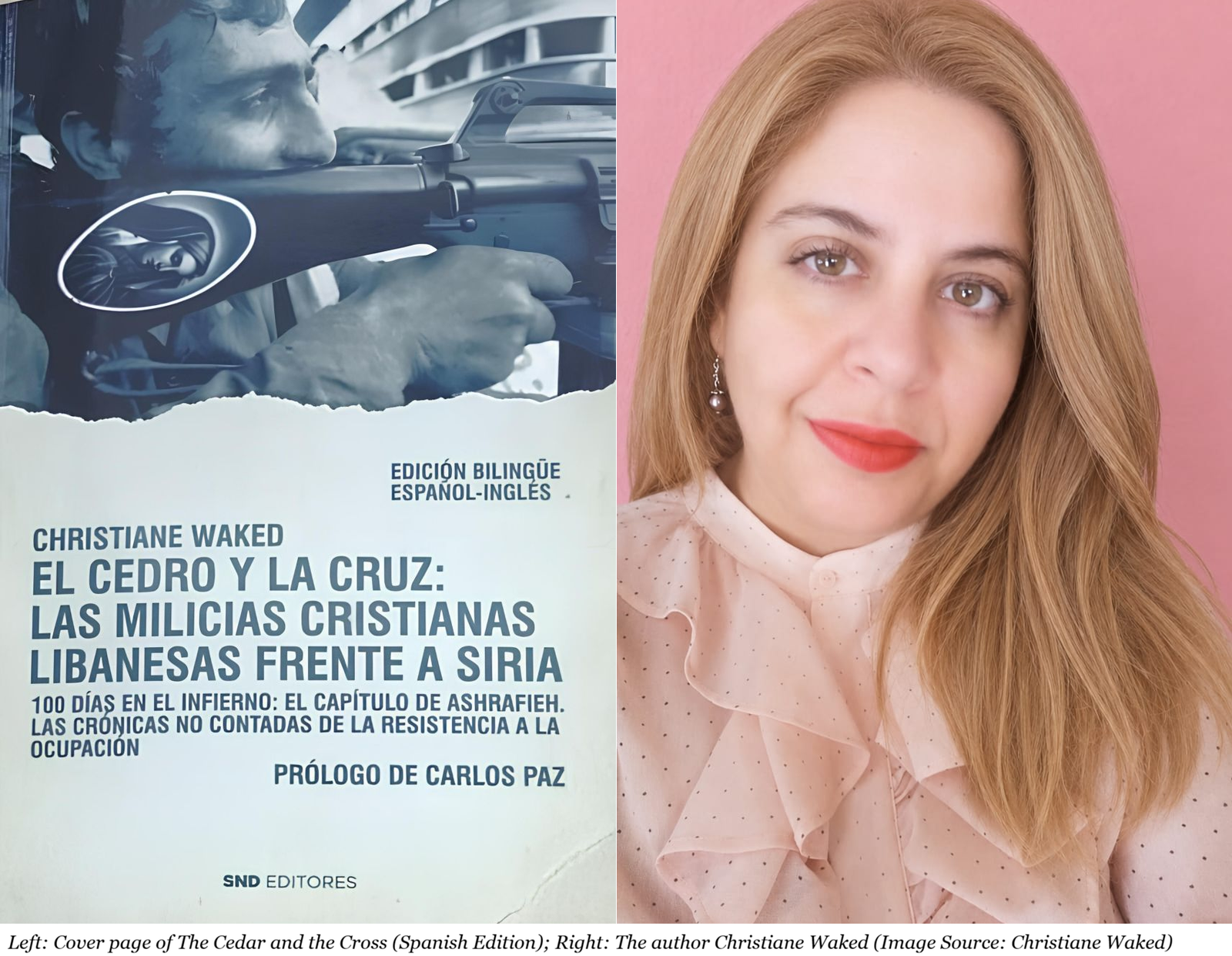
Lebanon's Civil War remains one of the most complex and least understood conflicts of the twentieth century. While much attention has been devoted to its political and regional dimensions, many of its defining battles and the experiences of those who lived through them have remained largely absent from the international historical narrative. The Cedar and the Cross in its bilingual edition Spanish-English seeks to address this gap by documenting the Hundred Days War of 1978, the Syrian Army's siege of the Christian district of Achrafieh in Beirut, through a combination of historical research, eyewitness testimony and personal memoir.
According to the author, understanding the Hundred Days War requires examining the broader developments that preceded it. The book argues that Lebanon's internal equilibrium was profoundly destabilized by the transfer of the Israeli-Palestinian conflict onto Lebanese territory, followed by successive foreign interventions that transformed the country into a battleground for competing regional interests. Within this historical framework, the siege of Achrafieh is presented not merely as an isolated military engagement but as a pivotal episode in Lebanon's struggle to preserve its sovereignty and social fabric.
The project was born from a deeply personal motivation. Following the death of her parents, Joseph and Hilda, the author felt compelled to preserve the story of what they, her family and her city endured during the war. Their passing represented the loss of a generation whose experiences risked disappearing without ever being recorded. The book therefore serves simultaneously as a historical study and as a tribute to those whose sacrifices have remained largely unknown outside Lebanon.
A central contribution of The Cedar and the Cross lies in its methodology. The author conducted extensive archival research while collecting testimonies from veterans of the Lebanese Christian resistance who participated directly in the Hundred Days War. These first-hand accounts enabled the reconstruction of military operations with considerable precision, examining defensive positions, battlefield tactics, command structures, logistical challenges, weapons systems and the strategic decisions that shaped the outcome of the battle. Rather than presenting a purely political narrative, the work offers a detailed operational history grounded in the experiences of those who fought.
The military analysis is complemented by an equally important human dimension. The book documents the daily lives of civilians trapped under relentless bombardment, describing how entire families survived in underground shelters while, according to eyewitness accounts, up to one hundred artillery shells fell every minute upon Achrafieh and Ain El Remmaneh. Medical personnel, volunteers and ordinary citizens are portrayed alongside the combatants, illustrating how civilian resilience became an essential component of the city's defence.
Among the individuals highlighted is the author's uncle, Elie Waked, then a second-year Political Science student who interrupted his university studies to defend his village armed only with a hunting rifle. His decision, motivated by the determination to protect his family, his community and his church, symbolizes the experience of many young Lebanese who found themselves thrust into war without military training.
Religious faith also occupies a significant place throughout the narrative. The author examines how spiritual life sustained both combatants and civilians during the siege. Fighters frequently carried rosaries or crosses before entering battle, while women gathered in bomb shelters to pray the Rosary collectively as artillery fire continued above them. These practices are presented not simply as expressions of personal belief but as sources of psychological endurance and communal cohesion under extreme conditions.
Beyond documenting the battle itself, The Cedar and the Cross explores the long-term consequences of the conflict. Although the defenders successfully resisted the siege, the author argues that the battle was followed by nearly three decades of Syrian military presence and political dominance in Lebanon, profoundly influencing the country's subsequent history.
The volume also includes a foreword by Carlos Paz, geopolitical analyst and director of Tablero Internacional, who situates the Hundred Days War within the wider strategic dynamics of the Middle East. His contribution highlights the importance of recovering overlooked historical episodes in order to better understand the geopolitical evolution of the region and the enduring consequences of foreign intervention in Lebanon.
Ultimately, The Cedar and the Cross aspires to be more than a historical reconstruction. It seeks to preserve collective memory, honour those who endured one of Lebanon's darkest chapters and contribute to scholarly and public discussions on war, sovereignty, national identity and historical remembrance. Through its combination of archival research, oral history and personal testimony, the book offers an interdisciplinary perspective that bridges military history, political analysis and human experience, while encouraging readers to reflect on how the lessons of Lebanon's past may remain relevant to contemporary societies confronting questions of security, social cohesion and political stability.
Book Details
Title: EL CEDRO Y LA CRUZ: LAS MILICIAS CRISTIANAS LIBANESAS FRENTE A SIRIA (Bilingual Spanish-English Edition)
Author: Christiane Waked
Pages: 199
Publisher: SND Editores
Book Available On: www.amazon.es