


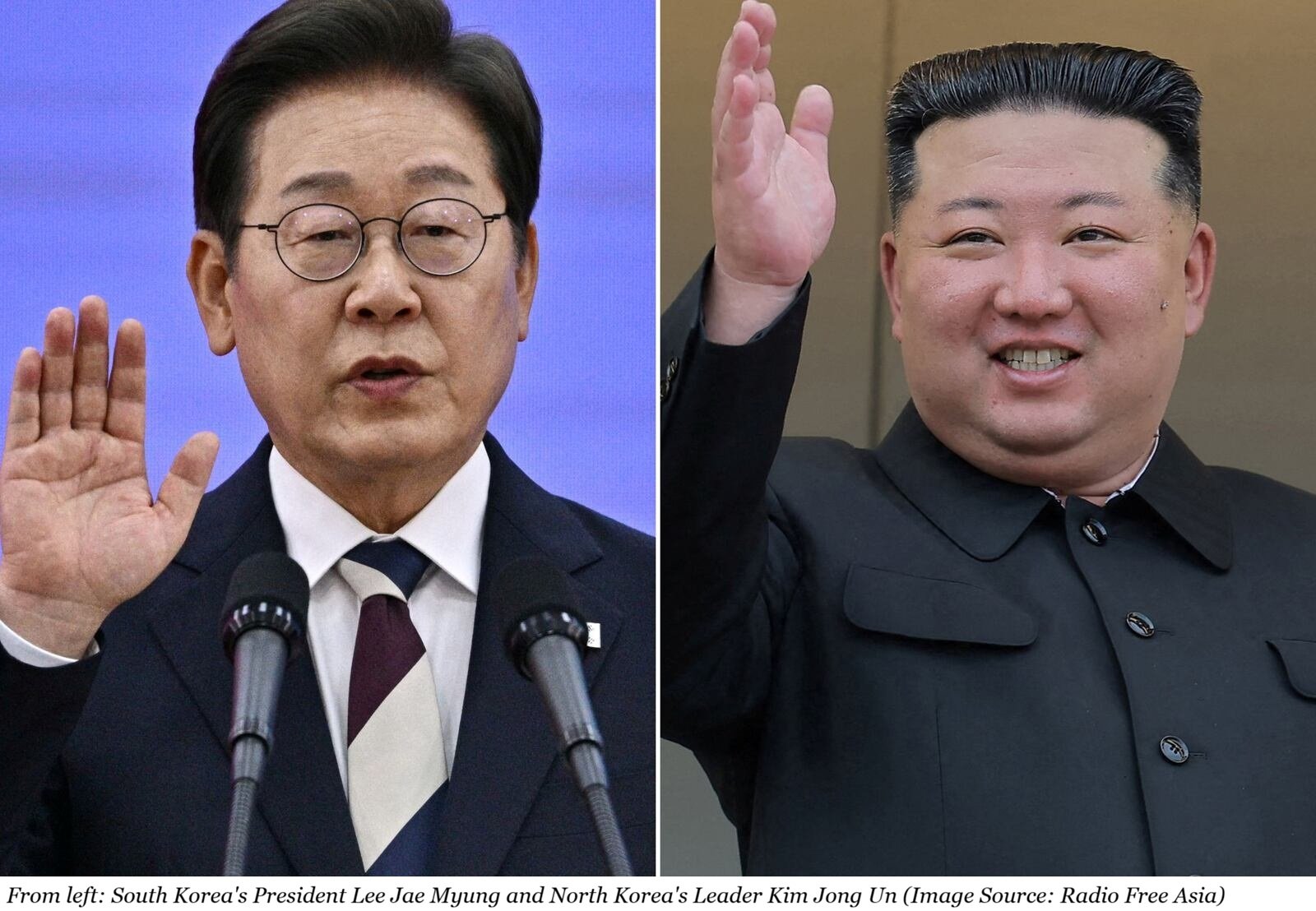
On 12th October North Korea launched a number of ballistic missiles, just a few days after South Korea had itself tested a new hypersonic weapon. On the surface this is yet another episode in the long-running military standoff between the two Koreas. The real issue though is whether a strategy which is designed to prevent war could in fact end up increasing the risk of war.
This is the problem with deterrence really. Each country builds up its military to scare the other country into not attacking. If both sides do this then one side's defence can look like a threat to the other.
In other words, if one country is trying to feel safe the other country is going to feel less safe.
For North Korea the nukes are primarily a tool of state survival. Kim Jong-un believes that if he has a strong nuclear capability then the US and South Korea won't attack. The nukes also give North Korea leverage over other countries and give it more power in negotiations.
South Korea is of a completely different mind. Given that North Korea has nukes and is constantly testing missiles and making threats, South Korea feels it's in a position where it needs to beef up its own military and arsenal.
That's why South Korea is developing very fast missiles. From the North Korean perspective though, these new weapons could pose a threat to key areas of their own country.
The key issue isn't so much what each country intends to do as what the other country thinks it might do.
The problem is that as the missiles get more sophisticated the issue gets worse. Some of the new missiles (the hypersonic ones for example) are very hard to see or engage. They also give the country considerably less time to react if anything goes wrong.
A nation which is fearful of being caught by surprise might feel it has to strike first.
This doesn't mean either North or South Korea want war at this moment. The new technology is making their armies more capable and the leaders are having less time to think before they act.
And with nuclear weapons involved, even a small error can have massive and potentially catastrophic consequences.
The US adds another layer to this equation.
For years America's military protection has been the cornerstone of South Korea's security. The key for Washington is to convince Pyongyang that an attack on Seoul would be met with a very significant American response.
But that very commitment creates a very difficult balancing act. You have to reassure your ally without in any way encouraging the very thing that could lead to an uncontrolled confrontation.
There's another question as well. As North Korea develops missiles capable of hitting US territory, South Korea may well ask whether Washington would really be prepared to risk its own cities in order to defend Seoul.
This does not mean that the US would walk away from South Korea. It's just that the very uncertainty surrounding US’s intentions could be a factor in Seoul moving towards greater military autonomy.
Here's another paradox: the more North Korea is able to deter the US, the more it may prompt South Korea to beef up its own military.
But Does Kim Jong-un Actually Want a War?
There's another interpretation as well. North Korea's military posturing may be intended to bolster its negotiating position.
Pyongyang may be using the display of increasingly sophisticated weaponry as a means of securing international recognition of its nuclear status and to make it clear to Washington that any future agreement must factor in its military capabilities.
Its relationship with Russia is growing and that does give Kim Jong-un additional diplomatic and strategic options. More confidence doesn't necessarily lead to more caution though and at times it may actually lead to more dangerous decisions.
This doesn't mean that Russia or China want a new Korean war. Both have very good reasons to avoid a major conflict in the region.
The real issue may be somewhere else entirely in that deterrence is most effective when you've got military strength coupled with communication.
During the Cold War there was a gradual development of mechanisms to reduce the risk of misunderstanding, even as the two sides maintained absolutely massive nuclear arsenals.
On the Korean Peninsula political dialogue has effectively collapsed. North Korea has given up on the reunification objective and now talks of South Korea as a separate hostile state.
This makes military incidents far more difficult to deal with, particularly when each side is reading the other's actions through the lens of fear and mistrust.
Three Possible Scenarios
The first is continued armed stability. Both Koreas are building up their forces, but are avoiding any confrontation as they both know what a price war would exact.
The second is accidental escalation. A border incident, a missile test or a misinterpreted military action could be the catalyst for a chain reaction which neither government would have wanted.
The third is a diplomatic opening. Washington and Pyongyang could in principle go into discussions about reducing military risks, even if the nuclear issue wasn't resolved. That would of course raise the question of South Korea's role in any decisions which would have a direct impact on its own security.
None of those outcomes is inevitable.
The Korean peninsula is a classic example of the paradox of international relations in that more military power does not necessarily equate to greater security.
Deterrence is still required in the face of a credible nuclear threat and it would be utterly unrealistic to suppose that South Korea would in any way scale back its defences simply because North Korea sees them as a threat.
But it would be equally foolish to think that more missiles, faster weapons and stronger military capabilities in themselves will ensure peace.
The real issue isn't simply which of the Koreas is going to end up the militarily stronger one. It's whether they can both have credible deterrence and sufficient political restraint to avoid a crisis escalating into a war.
The biggest threat on the Korean Peninsula may not actually be the result of a decision to go to war.
It may come from a moment when both sides are convinced that acting first is the only way to protect themselves.
(Gilles Touboul is a geopolitical analyst and former international currency trader with expertise in Middle East and Asia)