


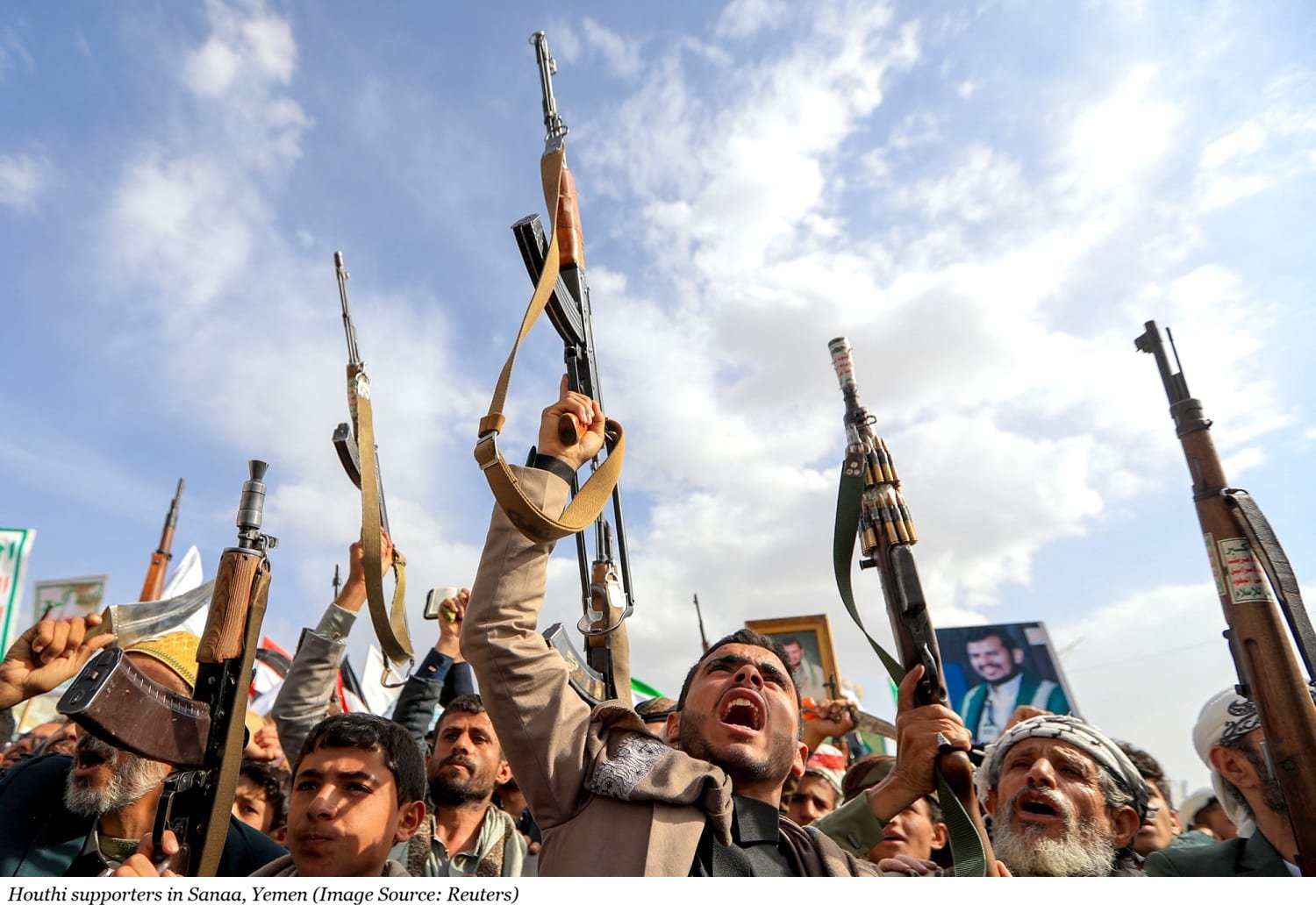
On 10 November, residents of Riyadh received phone alerts instructing them to seek shelter from an “aerial threat.” This marked the third consecutive day of such warnings. Saudi air defences intercepted missiles targeting the capital. The previous day, debris from an intercepted Houthi missile damaged an Aramco office building in the King Abdullah Financial District. In Yemen, the Houthi-run health ministry reported that Saudi airstrikes near Sanaa over the weekend killed at least 44 people, although this figure has not been independently verified.
A senior Houthi official vowed to “punish the Saudi regime for its crimes against the Yemeni people”. In response, Riyadh is reportedly preparing for a protracted campaign.
While global attention has focused on the Strait of Hormuz, a second front has emerged in West Asia. This development holds significant implications for India.
How the Truce Collapsed?
From 2022 until mid-2026, a United Nations-brokered truce was largely maintained between Saudi Arabia and the Houthis. The onset of the war with Iran ended this truce.
The escalation began in July when an Iranian aircraft attempted to land in Sanaa without Saudi authorisation, prompting strikes on Sanaa airport. International media reports indicate that the Saudi strikes aimed to disrupt regular Iranian shipments of missile and drone equipment, advisers, and personnel. In response, the Houthis declared a naval blockade of Saudi Arabia and targeted Aramco facilities at Jizan and Yanbu. By September, Houthi forces had advanced toward government-held areas near Mokha and territory bordering the Bab el-Mandeb strait.
Subsequently, the conflict extended to Saudi cities. On 10 October, a strike on Riyadh’s King Khalid International Airport killed 12 people and injured more than 300, according to Saudi authorities. Attacks on airports, oil fields, and pumping stations have persisted since then.
The Houthis have publicly demanded that Riyadh abandon support for Yemen’s internationally recognised government, lift all restrictions on ports and airports under Houthi control, and pay war reparations. These conditions are unlikely to be met in the near future.
Why the Red Sea, and Why Now?
The timing of these developments is deliberate. Following the closure of the Strait of Hormuz by Iran, Saudi Arabia redirected much of its exports to the East-West pipeline, which transports crude oil to Yanbu on the Red Sea. Between March and mid-July, Saudi seaborne crude exports through the Bab El-Mandeb were eight times higher than during the same period in 2025.
This route became Riyadh’s primary alternative to circumvent the Hormuz closure, thereby making it a strategic target. As one analysis observes, “The Houthis do not need to close the Bab El-Mandeb completely”. Increasing the perceived risk is sufficient to raise costs, divert shipping, and reduce Saudi revenues. Analysts characterize the Houthi strategy as an attempt to replicate Iran’s approach to the Strait of Hormuz.
India’s Exposure
• Energy: This is where the issue becomes directly Indian. In February 2026, Saudi crude reached India almost entirely through Hormuz. By the second half of April, shipping data showed it was loading almost entirely at Yanbu instead. The route India relied on to get around Hormuz now runs within range of Houthi missiles.
• According to Kpler, 6–7 million barrels a day of crude pass through the Bab El-Mandeb, nearly half of its Saudi crude from Yanbu. Analysts expect that disruption would make supplies more expensive rather than stop them. Cargoes can be routed through Egypt’s SUMED pipeline or around the Cape of Good Hope, but each detour adds time and insurance costs. India has cushioned the shock by buying more Russian crude, which accounted for nearly 55% of its imports in July. That shift has limits.
• People: Saudi Arabia hosts a substantial Indian expatriate community, and the conflict has already resulted in Indian casualties. One Indian national was killed and 11 were injured in the Riyadh airport attack. The Ministry of External Affairs (MEA) confirmed that another Indian was killed in an attack on Dammam airport. The Indian Embassy in Riyadh has repeatedly advised nationals to remain indoors during aerial threats.
• Trade: The Red Sea serves as India’s principal maritime route to Europe via the Suez Canal. Instability in this region increases freight costs for Indian exporters and raises concerns about the long-term viability of the India-Middle East-Europe Corridor (IMEC) maritime links.
India’s Response So Far
New Delhi has articulated a clear stance regarding attacks on civilians. The Ministry of External Affairs (MEA) has described the targeting of civilian infrastructure as “completely unacceptable” and expressed solidarity with Saudi Arabia. The MEA has also voiced deep concern about the escalation in the Red Sea region.
This position remains consistent and defensible. Condemning attacks on civilians does not equate to taking sides in Yemen’s civil war. India also has a notable humanitarian record in Yemen. In 2015, Operation Raahat evacuated nearly 5,600 individuals from the country, including approximately 960 foreign nationals from 41 countries.
What India Should Consider?
• Treat Hormuz and the Red Sea as a single problem: An energy security plan that covers one chokepoint but not the other is incomplete. India’s diversification has to assume both could be disrupted at the same time.
• Strengthen its naval presence: The Indian Navy has long maintained a presence in the Gulf of Aden. A sustained, visible deployment near the Bab el-Mandeb would protect Indian-flagged ships and crews, and show that India intends to protect its own interests.
• Use the channels that reach the Houthis: Oman brokered a ceasefire between the US and the Houthis in 2025, and Muscat remains one of the few capitals that can talk to all sides. India does not need direct contact with the Houthis to influence events. It needs closer coordination with the states that have that contact.
• Evacuation Plan: The size of the Indian community in Saudi Arabia means contingency planning should be done now, not after a crisis begins.
The Bottom Line
Over the past eight months, international attention has focused on the Strait of Hormuz. During this period, a second chokepoint has come under strain, and the ongoing conflict has extended to Saudi cities, Gulf airports, and the alternative route that sustained Indian refineries.
The central issue for New Delhi is not the significance of the Red Sea, but whether India’s strategic planning accounts for the possibility that both chokepoints could be threatened simultaneously.
(Rohan Ambike is a Pune-based translator and geopolitical researcher specialising in West Asia and counter-terrorism, and the author of Shadow War: Iran, Israel, and the West’s Fatal Miscalculation)