


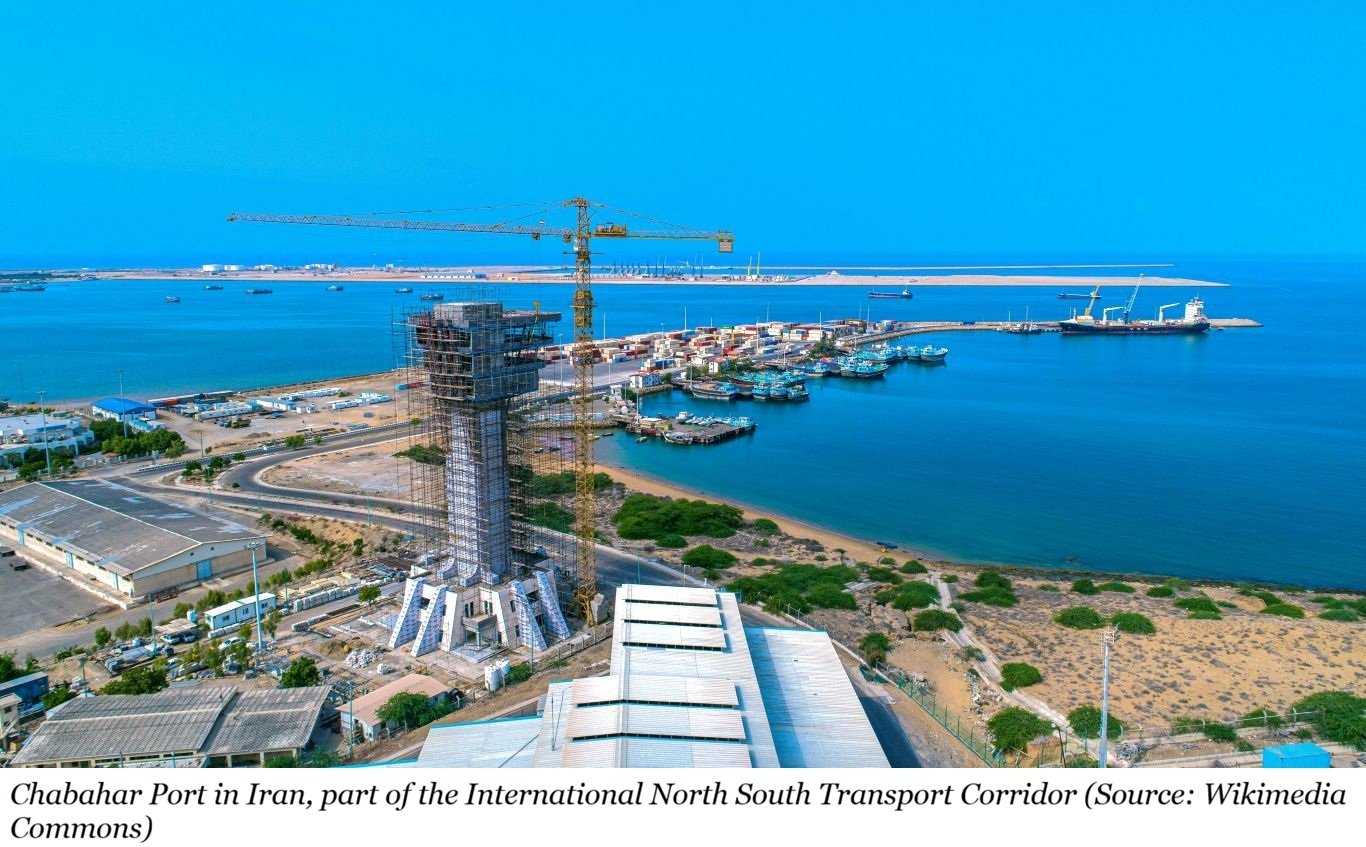
The war in Ukraine is often framed as a European tragedy. Yet its ripple effects extend far beyond the battlefields of Donbas and the Black Sea. Eurasia, once imagined as the connective tissue linking Europe and Asia, has become a zone of fragmentation. The conflict has disrupted supply chains, energy routes, and diplomatic alignments, leaving Asia’s strategic corridors in a state of flux. For Asian powers, particularly India, this disruption is not peripheral but central to the future of connectivity, energy security, and geopolitical strategy. The Ukraine war has forced a rethinking of how Asia links to Europe and whether the Indo-Pacific, rather than continental Eurasia, will anchor the next phase of global connectivity.
Eurasia’s Corridors Before the War
Before February 2022, many viewed Eurasia as the centre of global connectivity. China’s Belt and Road Initiative (BRI) sought to tie Central Asia, Russia, and Europe into a vast economic network. For India, the International North-South Transport Corridor (INSTC) linking Mumbai to Moscow via Iran promised faster and cheaper trade with Russia and Europe. Russia’s gas pipelines to Germany embodied Eurasia’s role as an energy hub, binding continents.
These projects assumed a degree of stability where, despite political tensions, trade and transport could flow relatively unhindered. Eurasia was less a battleground than a bridge. The war in Ukraine shattered that assumption, forcing governments and corporations alike to recalibrate how they viewed overland corridors across the heart of Eurasia.
The War’s Disruption: Breaking Old Links
Russia’s invasion of Ukraine and the sweeping Western sanctions that followed severed Moscow’s economic integration with Europe. Energy flows to the EU collapsed almost overnight, forcing Europe to seek alternatives in the Middle East, Africa, and the Americas. Russia, in turn, pivoted eastward, deepening its dependence on China and expanding ties with Iran.
Eurasia’s corridors, once envisioned as neutral spaces of transit, became politicized and contested. The North Sea–Baltic–Black Sea linkages were disrupted, the northern BRI routes became riskier, and the INSTC faced new headwinds. The Ukraine war has thus accelerated a trend of corridor diversification, where Asian powers are reimagining connectivity away from overreliance on Eurasia.
Corridor Politics: Competing Asian Responses
The fragmentation of Eurasia has produced competing visions for alternative corridors.
• China has doubled down on the BRI, particularly its Central Asian branches. Beijing’s alignment with Moscow ensures that Russia remains part of China’s land-based connectivity vision. Projects such as the Power of Siberia pipeline and China–Central Asia rail links show that while Europe turns away from Russia, China turns toward it.
• India has revived interest in the INSTC, hoping to bypass Europe by connecting with Russia via Iran. Yet sanctions on both Moscow and Tehran make this path politically fraught. At the same time, India has championed the India–Middle East–Europe Corridor (IMEC), announced at the 2023 G20 summit. IMEC promises to connect India to Europe through the UAE, Saudi Arabia, and the Mediterranean; however, instability in the Middle East raises concerns about its viability.
• Turkey has promoted the so-called Middle Corridor, a trans-Caspian route connecting Central Asia to Europe while bypassing Russia. Backed cautiously by the EU and welcomed by Central Asian states wary of overdependence on either Moscow or Beijing, this corridor has gained momentum.
• The Gulf States have emerged as new corridor hubs. The UAE and Saudi Arabia are investing heavily in port and logistics infrastructure, positioning themselves as gateways for Asia–Europe trade. Their entry into BRICS+ underscores their role as connectors across Eurasia and the Indo-Pacific.
In short, the Ukraine war has transformed corridor politics into a competitive arena where land and maritime strategies intersect and where middle powers, not just great powers, are shaping outcomes.
India’s Strategic Dilemma
For India, Eurasia’s flux presents both opportunity and dilemma. The INSTC, long touted as a counterweight to China’s BRI, faces the dual challenge of Western sanctions and inadequate infrastructure. While it offers strategic depth, its dependence on Russia and Iran makes it vulnerable to geopolitical volatility.
IMEC, in contrast, has the advantage of aligning with India’s partnerships with the U.S., the EU, and the Gulf monarchies. Yet its political fragility cannot be ignored. The recent escalation of Israel–Iran tensions has exposed just how precarious Middle Eastern connectivity can be.
Caught between these options, India is increasingly looking to the seas. Maritime corridors linking India to Africa, the Gulf, and Europe may prove more resilient than contested Eurasian land routes. Initiatives like SAGAR (Security and Growth for All in the Region) and trilateral partnerships with Japan and African states highlight this shift. India’s diplomatic strategy now involves balancing continental corridors with maritime ones, ensuring it is not trapped in Eurasia’s instability.
The Future of Asia’s Corridors
The Ukraine war has demonstrated that connectivity is never politically neutral. Corridors are not just trade routes but strategic instruments, vulnerable to conflict and realignment. Eurasia’s traditional role as the land bridge between Europe and Asia has weakened, while the Indo-Pacific and Middle East are emerging as alternative hubs of connectivity.
Asia’s future corridors are likely to be hybrid, blending land and maritime routes, involving not only great powers but also middle powers like Turkey, Saudi Arabia, and the UAE. For India and other Asian actors, the challenge is to craft corridors that are geopolitically sustainable, economically viable, and strategically autonomous.
Conclusion
Eurasia is in flux, and so too is the global map of connectivity. The war in Ukraine has not just redrawn borders in Eastern Europe; it has redrawn the very logic of how Asia connects to Europe. What was once assumed to be a seamless land bridge is now fractured, contested, and uncertain. India’s dilemma reflects the broader Asian challenge: whether to persist with fragile overland corridors through a turbulent Eurasia or to shift decisively toward maritime and hybrid models of connectivity. Ultimately, states' ability to adapt to geopolitical shocks will dictate the future of Asia's strategic corridors, not just geography. The choices made in this decade will shape not only trade routes but also the balance of power across Eurasia and the Indo-Pacific for decades to come.
(Dr. Amit Kumar Singh is a researcher in international relations with core specialization in India’s foreign policy, Indo-Pacific studies, maritime security and geopolitics. Follow him on X: @Raghuwansh_amit)