


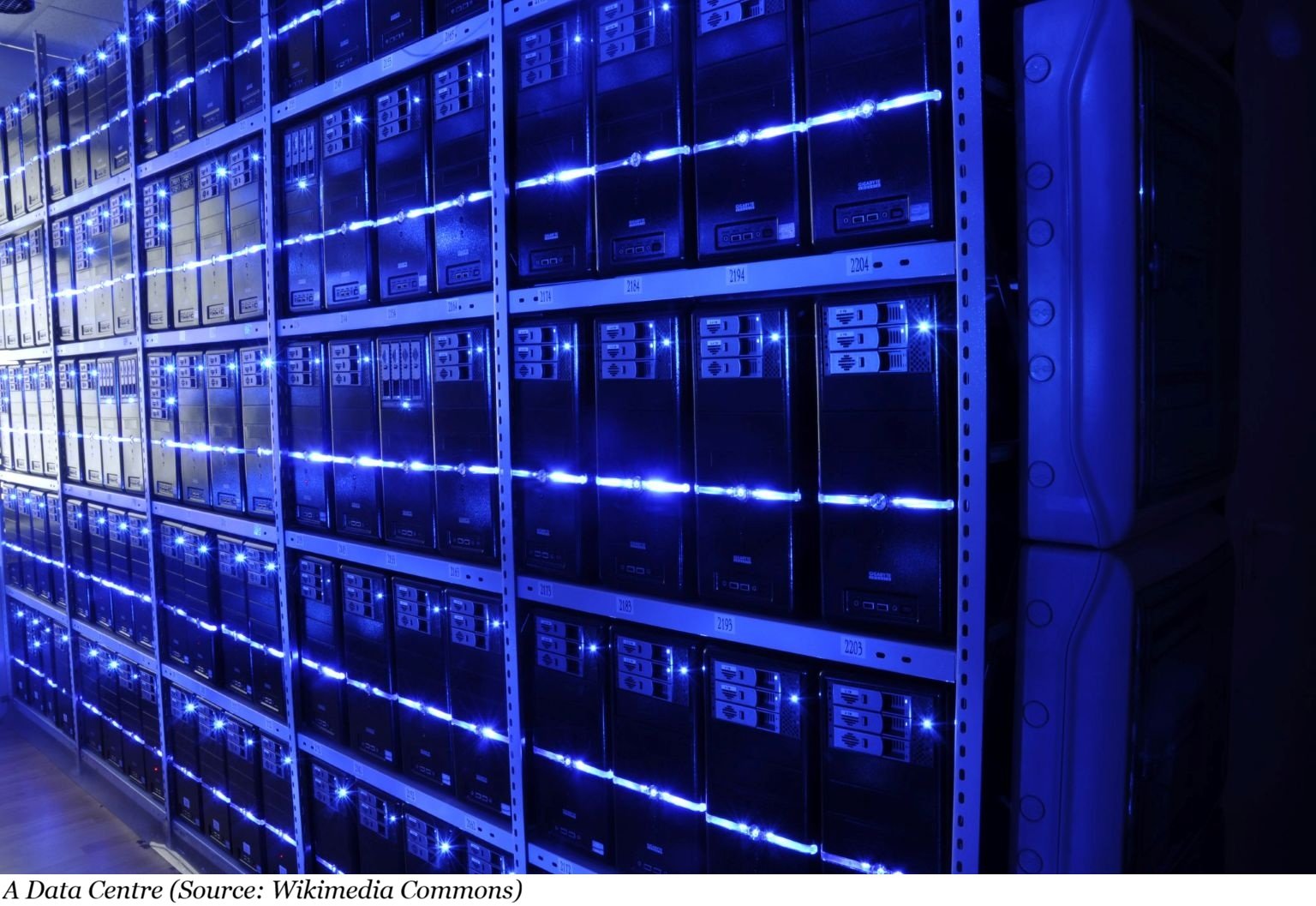
This piece aims to shed light on how data—and the physical infrastructure supporting it—shape international relations and foreign policy worldwide. In this day and age governments and Big Tech are choosing the path to further deepening the effects of energy gentrification while further polluting space and our planet’s ground, waters and atmosphere. As the Sustainability directory frames, energy gentrification is; “a socio-spatial process characterized by the displacement or marginalization of vulnerable populations resulting from energy-related interventions”. Data infrastructure encompasses a vast, interconnected ecosystem of space-based systems, global communications networks, computing and storage facilities, power and cooling resources, legal and governance frameworks, and the people, technologies, and supply chains that sustain them. While adopting a global perspective, the focus will remain on Europe and the United States.
Tracing the material and social structures and the different ways data has been organized, managed and used at different historic moments, reveals a long history of power and violence closely linked to the control of information, population and connectivity. The first commercially successful transatlantic telegraph cable, born from prior colonial massacres and conquests, was laid in 1866 connecting Ireland to what is cited as “Newfoundland” (in that time one name for the territory was Ktaqmkuk, now part of Canada). As modern states consolidated in the early 20th century, wars in the colonies, civil wars and World Wars, further accelerated innovations in communications infrastructure, laying the groundwork for the first transatlantic fibre optic submarine cable in 1988.
Data is information that reflects human decisions, and ultimately serves as a tool for particular human led purposes. Thereby, it will never be neutral. The fact that data is a tool, means it can be used as a weapon for targeting, categorizing, separating or killing.
For instance, the Belgian colonial administration in Rwanda institutionalized ethnic categorization by including individuals' ethnic groups in their identity documents. This policy later facilitated divisions contributing to the Rwandan Civil War and the 1994 genocide against the Tutsi people. There are examples in our history that show how sabotaging a human made decision to collect certain data has deferred from killing. During World War II, René Carmille, a French civil servant, manipulated the functioning of Hollerith punch-card machines to prevent the Nazis from registering the religion of French civilians. By deliberately omitting this data, Carmille slowed the identification, deportation and assassination of Jews in France.
Since information and data can ultimately be used to target, repress or kill, it is extremely worrying that a bunch of companies concentrate the control of the majority of our world's data.
Nowadays, Tech giants are choosing the path to further build data centres on water scarce regions, offset their emissions, go nuclear, build hyperscale data centres, invest in satellites and a considerable number of submarine cables. While configuring a significant part of the global infrastructure for social media and cloud services, the Big 5 — Google, Microsoft, OpenAI, Meta, and Amazon — are also aligning their technology for military purposes.
Few threats capture the paradox of our technological progress as vividly as the Kessler syndrome. This scenario foresees a future where the density of space debris grows so high that each collision spawns even more debris, setting off a chain reaction of impacts. Over time, this cascade could wrap Earth in a dense shell of orbital junk, isolating our planet within its own debris field. To manage this risk, NASA and the European Space Agency set a collision probability at 1 in 10,000. In 2024, Starlink adopted a far more conservative standard—1 in 1,000,000—adjusting its satellites’ positions every 30 seconds to avoid potential impacts. Yet as Earth’s orbit becomes increasingly crowded and satellites maneuver more often, the possibility of a runaway collision chain continues to grow.
From Cloud to Matter
An estimated 99% of intercontinental data is transmitted through submarine cables, rather than via satellite. Despite more than 11,700 satellites currently orbiting the Earth—including at least 608 dedicated to enabling modern military operations and over a thousand observing Earth—undersea infrastructure remains the backbone of the global Internet.
As of 2025, there are at least 597 active submarine cable systems, with an additional 81 planned. Together, they span approximately 1.48 million kilometres and connect to 1,712 landing points, forming the backbone of global telecommunications. Data generated on our planet is stored in over 11,800 data centres worldwide, where only in 51% of these centres water usage is disclosed.
Since the quote “Data is the new oil” was said in 2006, the world’s data has increased at least 1,088 times, from 161bn GB to a minimum estimate of 175 trillion GB. Today, data infrastructure is consuming so much energy that entire communities are left with residual water or limited electricity, while companies reap profits behind the veil of innovation and sustainability pledges. Even arms manufacturers have raised concerns about their inability to scale production due to the energy demands of neighbouring data centres.
Going back a bit, foreign interest in oil not only has fuelled a resource competition race, but also has welcomed foreign interventions in countries rich in this natural resource. Leaving a trail of pollution and unstable regimes in nations like Syria, Iraq, Libya, Iran, Yemen, Nigeria, Chad, South Sudan, Angola, and Sudan. Through economies of scale, offset projects, and selective auditing practices, oil companies create markets of deniability that allow them to operate with minimal accountability in highly volatile environments. Today’s data and tech giants seem to be following a similar path, reproducing the same consequences to local inhabitants, governments and the environment.
Digital infrastructure, particularly data centres, is expanding into regions facing water scarcity. Companies often exploit legal grey areas and local vulnerabilities, enjoying tax breaks, consuming disproportionate amounts of community energy and resources, while keeping job creation to the bare minimum. Big Tech companies are building mega projects in areas with low employment rates as illustrate the cases of Meta’s data centre in Talavera de la Reina (Spain) or Querétaro’s data centre hubs (Mexico). This digital-era competitiveness is driving us to “energy led gentrification”.
The parallels between the oil rush of the past and today’s race for digital dominance are too striking to ignore. Both have relied on concentrated control of critical resources, operated with minimal transparency, and left lasting social and environmental scars on the communities that host them. In the case of digital infrastructure, the resource at stake is not just energy, water, or land—it is the very capacity to store, process, and move the world’s information. The expansion of data centres, satellites, and submarine cables is shaping a new geopolitical map where technological power mirrors and amplifies existing inequalities. Unless governance frameworks evolve to address the environmental, social, and strategic costs of this expansion, energy-led gentrification will become a defining feature of the digital age—entrenching a future where the benefits of connectivity are enjoyed by the few, while its burdens are borne by the many.
(Carla Martínez is an investigative researcher specializing in technology, arms trade, corruption, and environmental and social issues)