


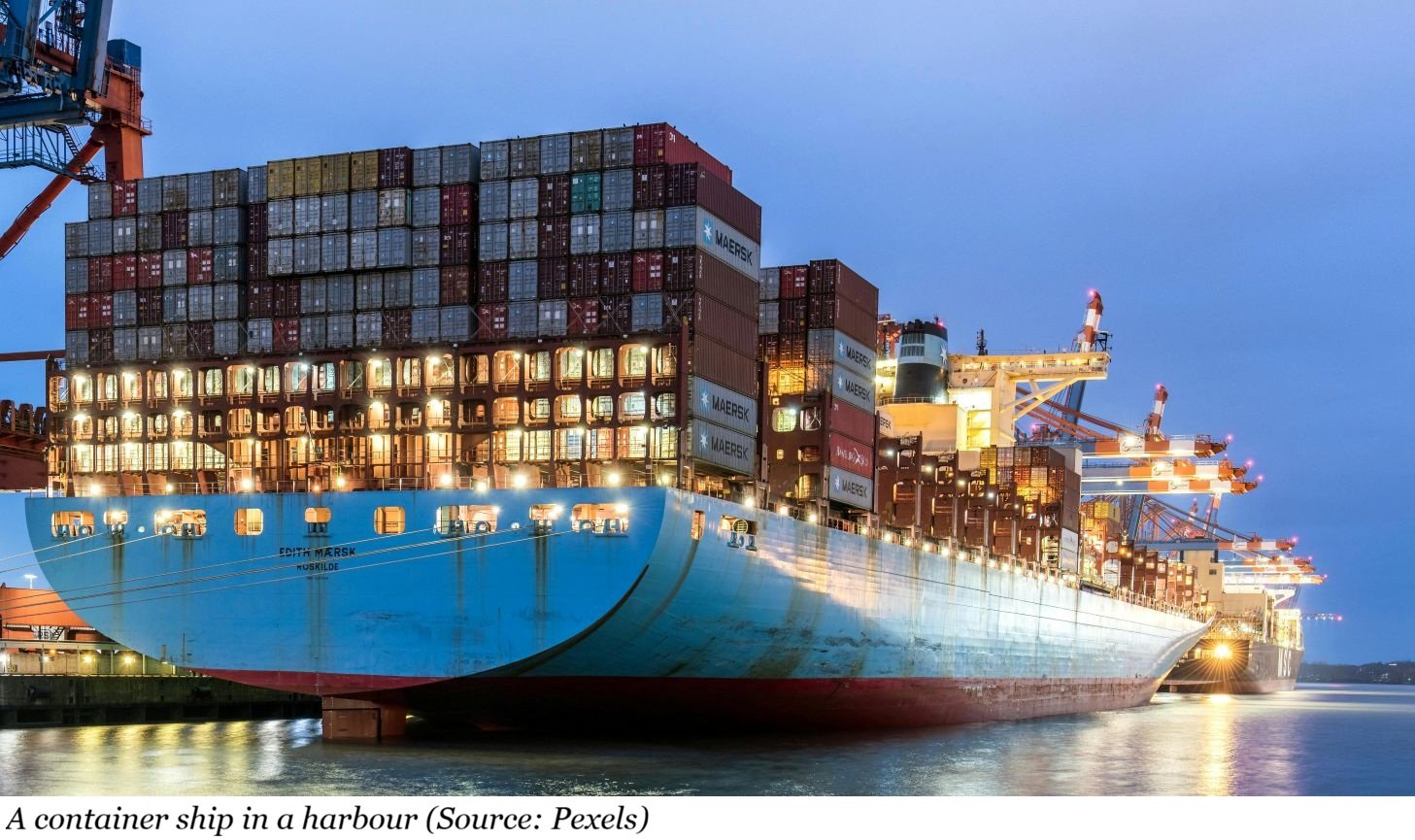
Maritime chokepoints have repeatedly reshaped global trade—from the 1956 Suez Crisis that shut the canal for nearly five months, cutting off two-thirds of Europe’s oil supplies Imperial War Museums to the week-long Ever Given blockage in March 2021, which held up US $9 billion of goods per day. The present Red Sea crisis is markedly different: beginning in December 2023, sustained Houthi missile and drone attacks have slashed standard Suez transits by nearly 60% and propelled maritime traffic to detour via the Cape of Good Hope. The strategic and economic consequences are profound—freight economics, port hierarchies, and maritime security strategies are being fundamentally reconfigured.
Crisis Overview and Timeline
In December 2023 Yemen’s Houthi movement began a sustained campaign of missile and drone attacks on merchant shipping in the Bab el-Mandeb and the southern Red Sea. The uptick in attacks prompted immediate industry and state responses as merchant vessels became direct targets and naval escorts were deployed to protect convoys.
Major container carriers quickly withdrew or rerouted services to avoid the corridor. Public statements and notices from liners confirm the operational shift: Maersk updated contingency surcharges and route notices; Hapag-Lloyd posted rerouting notices and live tickers; CMA CGM issued force-majeure / reroute advisories. Reuters contemporaneously reported on carrier reroutes around southern Africa.
Rerouting via the Cape of Good Hope meaningfully lengthened voyages. Authoritative industry and UN analysis put the additional distance and time at roughly an extra 3,500–4,000 nautical miles and ~10–14 days for Asia–Europe sailings (UNCTAD and industry reporting show an additional ~12 days on many Asia–Europe services). The longer route also raises bunker consumption, voyage costs and emissions, and reduces weekly vessel rotations — a structural hit to schedule reliability.
War-risk and operational insurance costs rose sharply. Reporting based on market and insurer sources documents war-risk surcharges and premiums climbing to levels that in some cases approach or exceed USD 1m per voyage for high-value large containerships, substantially increasing total voyage costs and feeding through to spot and contract freight levels.
UNCTAD’s press analysis and the 2024 Review of Maritime Transport quantify the disruption: weekly Suez transits fell steeply and container spot rates jumped; UNCTAD’s route-specific calculations find that rerouting around Africa increased travel times materially (roughly +12 days on many Asia–Europe runs) and raised effective transport costs — evidence that the shock is systemic rather than episodic.
Quantifying the Trade Shock
Global freight markets have reacted swiftly to the Red Sea escalation. Drewry’s World Container Index (WCI) soared over 173% year-to-date by mid-Q1 2024, marking the highest levels since its inception in 2011. Concurrently, Xeneta data shows that long-term spot rates from Asia to Europe roughly quadrupled by early 2024 (Platts reported comparable jumps in rates to USD 6,500 per FEU for North Asia–Mediterranean services).
Transit times tell the same story. Aprile SpA estimates a 39% increase in Asia–Mediterranean transit times, with even steeper delays in parts of the Eastern Mediterranean.
Red Sea region ports bore the brunt. Sea-Intelligence analysis shows deep-sea calls fell by roughly 85% in early 2024, notably at Jeddah and King Abdullah Port; Gulf of Aden and East Mediterranean regions saw ~33% declines, with Salalah down around 50%. By mid-2024, only slight recovery was evident.
The fallout in transshipment hubs further underscores the shift. Lloyd’s List reports saw traffic surge in Colombo and Barcelona as carriers abandoned traditional East–West corridors, while Red Sea hubs lost significantly.
These logistics shifts have tangible knock-on effects. Industries reliant on Just-In-Time (JIT) deliveries—automotive, electronics, perishables—are seeing amplified delays. Estimated transport costs have risen as much as 250% per round trip (e.g., China to Netherlands), contributing to supply shortages and output declines.
UNCTAD finds that since December 2023, the Shanghai spot freight rate more than doubled (+122%), and rates to Europe tripled (+256%). The combination of rerouting and insurance surcharges has sparked inflationary pressures, particularly in developing economies.
Winners and Losers
Winners
1. Gulf Transshipment Hubs – Jebel Ali, Duqm, Salalah
The Cape of Good Hope reroute has shifted network gravity toward ports outside the Red Sea danger zone. Jebel Ali handled an estimated 4.5% more TEUs in Q1 2024 YoY (DP World operational data), while Salalah reported an ~11% jump in transhipment volumes (Port of Salalah statistics). Oman’s Duqm, though smaller, has marketed itself aggressively as a safe transhipment point for Europe-bound cargo, securing new service calls from carriers previously reliant on Port Said.
Why: These hubs sit on the revised Asia–Europe rotation path and have the draft depth, crane capacity, and feeder connectivity to absorb diversion traffic.
Implication: If security risks persist in the Red Sea, these ports could consolidate long-term roles in east-west liner schedules, potentially at the expense of some Mediterranean hubs.
2. India’s West Coast Ports – Nhava Sheva (JNPT) & Mundra
India’s JNPT saw a ~13% rise in containerized exports in H1 2024 compared to the same period in 2023 (Ministry of Ports data). Mundra, with its private-sector efficiency and rail hinterland access, recorded a similar ~12% increase in volumes (Adani Ports disclosures).
Why: West coast ports offer an alternative transhipment and consolidation point for cargo moving via the Cape, especially with improved feeder integration to Gulf hubs.
Implication: These gains could accelerate India’s ambitions to position itself as a transhipment rival to Colombo and as a central link in the proposed India–Middle East–Europe Economic Corridor (IMEC).
3. Shipping Lines with African Coastal Hubs
Lines operating African coastal hub strategies—such as Maersk (Mombasa, Cape Town calls) and MSC (Tema, Lomé)—have partially offset Cape detour inefficiencies by using these ports for mid-route cargo swaps.
Why: The ability to integrate African calls into the longer Cape loop adds revenue-earning port pairs and keeps ships fuller for more of the voyage.
Implication: Carriers with diversified hub networks are better positioned to turn a security crisis into a network optimisation exercise.
Losers
1. East African Exporters – Horticulture, Seafood, Coffee
Kenya’s flower exporters lost an estimated 35–40% of peak-season shipments to Europe in early 2024 (Kenya Flower Council estimates). Tanzanian and Somali seafood exporters saw price discounts and volume losses from reduced shelf-life. Ethiopia’s coffee shipments to Europe were delayed, missing contracted delivery windows.
Why: The Cape route’s extra 10–14 days erodes competitiveness for perishables and high-value agricultural commodities.
Implication: Without access to cost-effective air freight or faster sea–air links via Gulf hubs, these exporters face lasting market share erosion.
2. Mediterranean Transhipment Hubs – Port Said, Piraeus
Port Said throughput fell by ~13% in Q1 2024 YoY, while Piraeus saw a ~15% drop in transshipment volumes (port authority statistics).
Why: Both rely heavily on east–west Suez transits; rerouting to the Cape bypasses them entirely.
Implication: Without restored Suez flows or new service patterns, these hubs risk ceding their strategic importance to ports further south and east.
3. European Just-In-Time Manufacturing
Automotive plants in Germany, France, and Spain reported temporary slowdowns in early 2024 (ACEA data) due to parts shortages linked to delayed Asia–Europe shipments. Electronics assembly in Central Europe also faced component delays.
Why: Longer transit times disrupt the “zero-buffer” inventory model.
Implication: This may push manufacturers to diversify suppliers closer to Europe or hold more inventory—both of which have long-term cost and competitiveness impacts.
The Red Sea crisis has redistributed trade benefits and losses unevenly, privileging ports and operators that sit on or can pivot to the safer Cape route, while punishing those tied to the traditional Suez corridor or handling time-sensitive exports. The pattern mirrors past chokepoint crises but differs in its persistence—suggesting some of these gains and losses could harden into new structural trade geographies.
Strategic and Policy Implications
The Red Sea crisis underscores the strategic fragility of single-route dependency in global trade. The Suez Canal normally handles around 12% of global trade and 30% of global container traffic (UNCTAD, 2024). The Cape of Good Hope diversion has proven costly and time-consuming, with Asia–Europe voyage times rising by 10–14 day.
Push for the India–Middle East–Europe Economic Corridor (IMEC)
The European Union’s interest in operationalizing the India–Middle East–Europe Economic Corridor has intensified. Announced during the G20 Summit in September 2023, IMEC aims to connect India to Europe via the UAE, Saudi Arabia, Jordan, and Israel, offering a multimodal land–sea alternative to the Suez route. The Red Sea disruptions have added urgency to feasibility and financing discussions.
Naval Security Responses
The security dimension is equally significant. The EU Naval Force (EU NAVFOR) expanded its Operation Atalanta remit in early 2024 to include closer monitoring of the Bab el-Mandeb Strait, while the Indian Navy increased its anti-piracy and convoy escort operations in the Arabian Sea. Multinational task forces, such as the US-led Combined Maritime Forces, have also stepped-up patrols to deter further attacks.
Diversified Logistics Corridors & Overland Options
Policy thinktanks such as the International Transport Forum argue for investment in diversified corridors, including overland rail through Central Asia and maritime–rail hybrids via the Mediterranean and Black Sea. The Middle Corridor linking China to Europe through Kazakhstan, the Caspian Sea, and Türkiye has gained renewed interest as a partial hedge against maritime chokepoint risk.
The crisis has accelerated a multi-vector resilience agenda in trade policy—blending security cooperation, infrastructure investment, and route diversification. While security escorts may ease immediate risks, lasting resilience will depend on structurally embedding redundancy into global transport networks.
Conclusion
The Red Sea shipping crisis is not a transient distortion but a disruption that may reshape Asia–Europe trade patterns well beyond the resolution of current hostilities. Maritime analysts note that even if security in the Bab el-Mandeb improves, the established Cape of Good Hope service rotations could persist for cost or scheduling reasons, similar to how some Suez-avoidance measures lingered after the Ever Given incident in 2021.
The key lesson is that supply chain resilience must be built with the expectation of sustained geopolitical instability, rather than assuming disruptions will be short-lived anomalies. This requires planning for persistent route insecurity, volatile freight economics, and region-specific vulnerabilities—particularly for time-sensitive commodities and manufacturing sectors that rely on just-in-time flows.
Ultimately, the crisis calls for integrated maritime security—combining naval coordination under initiatives such as EU NAVFOR Operation Atalanta and Combined Maritime Forces—with trade diversification strategies like the India–Middle East–Europe Economic Corridor and expanded overland rail networks. Only by embedding redundancy into global transport systems can economies cushion themselves against the next chokepoint crisis, whether it arises from conflict, climate, or accident.
(Pallavi Das is a Doctoral Scholar in the Department of Studies in Economics and Planning at the Central University of Gujarat. Her research focuses on economic growth, inequality, trade strategy, and political economy, with a special interest in India’s evolving role in a multipolar world. She has published widely in academic journals and policy platforms, combining data-driven analysis with strategic insight. Pallavi has presented her work at national and international forums and is committed to bridging the gap between scholarly research and actionable policy)