


The ouster of the Sheikh Hasina-led Awami League government in Bangladesh in August 2024 has not only rendered the country unstable in political terms, it has also manifested severe fault lines that have already existed there since decades in a pronounced manner. While the upheaval in Bangladesh could be mistaken for a political tussle among rival factions, the events unfolding since past one year point more towards assertion of identity by the Muslims than an attempt to gain political space.
Identity is a complex and a multi-layered phenomenon that includes several factors like race, ethnicity, religion, language, geography and history.
Bangladesh, which came into existence over apparent cultural and linguistic differences with Pakistan, had been portraying its identity more in terms of language and culture of the land and not so much in terms of religion as is the case with Pakistan. The recent happenings in Bangladesh since August last year however have unmasked the radical Islamic ideology that has been hidden conveniently behind the smokescreen of Bengali language during past more than decades of existence of Bangladesh.
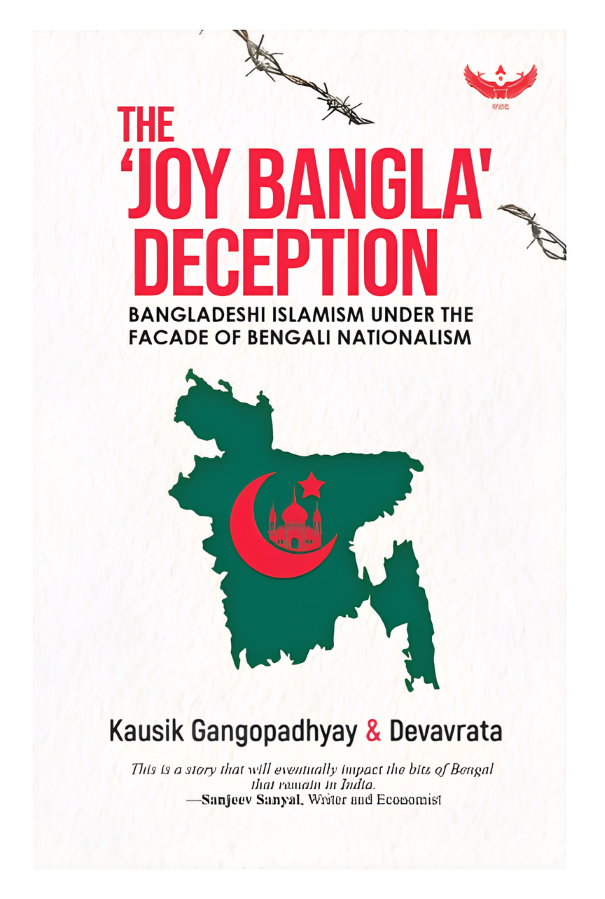
The book The ‘Joy Bangla’ Deception: Bangladeshi Islamism Under the Facade of Bengali Nationalism written by Prof. Kausik Gangopadhyay and Devavrata comes at a time when the minorities, particularly the Hindus, are increasingly facing persecution in Bangladesh at the hands of radical Islamists.
In this book, the authors have discussed how the identity factor has been calibrated by successive ruling dispensations in Bangladesh (civilian and military) to subtly advance the Islamization while putting on a garb of Bengali language.
While Bengali may have been mother tongue of majority people of Bangladesh, the under current within the political dispensation and religious leaders was always marked by an insecurity regarding the identity of the nation. Further, as the atrocities against the Hindus in Bangladesh may seem more pronounced and exacerbated since last one year due to the regime change. However, Hindus have always been persecuted by the Muslim majority in Bangladesh.
The premise of this book is how Bengali identity has been conveniently appropriated to gradually and subtly achieve the goal of Islamization of Bangladesh. Three major perspectives are at the core of this book. One, Bengali identity as a means to achieve a separate country. This follows the template of creation of Pakistan. Inability to accommodate within Pakistan was the popular cause of independence of Bangladesh. However, Sheikh Mujibur Rahman, a prominent figure in Bangladesh’s political history, was committed to Lahore resolution (that called for a separate country for Muslims). Since the resolution did not name any country Rahman conveniently interpreted it as a base to create another Muslim country. Rahman also remained a devout follower of Huseyn Shaheed Suhrawardy, the Muslim League leader who was responsible for mass killings of Hindus in Bengal in response to M.A. Jinnah’s call for Direct Action.
Two, Bengali language may have been one of the instruments for Bangladesh to separate from Pakistan. However, this same language was later used as a divisive tactic by the radical Islamic leaders – political and religious – in Bangladesh. To assert Islamic identity, the radicals in Bangladesh have even diluted the Bengali language with Arabic and Persian words to give it a more Muslim character. This phenomenon is also more than a century old. Rabindranath Tagore strongly criticized this Arabization of the Bengali language.
Three, the Joy Bangla slogan is also mostly misunderstood as a national slogan for Bangladesh. At the heart of this slogan lies the idea and the desire of the radicals to create a greater Bangladesh that includes significant portions of India’s West Bengal and Assam states where Muslims are in majority. Again this phenomenon points towards Islamic strategy of expanding borders (grabbing lands) to spread Islam.
Another important aspect is how Awami League has also not been an exception in the politics of either East Pakistan or Bangladesh. In the radical religious landscape of Bangladesh, Awami League has projected itself as a relatively secular party. However in the chapter Awami Muslim League: Religion at the heart of East Pakistan politics, Prof. Gangopadhyay and Devavrata have discussed how even this so-called secular party, which also presented itself as closer to the Bengali identity, was and is in fact no different from any radical Islamic outfit. Awami League was formed in 1949 as Awami Muslim League, after the creation of Pakistan, in an attempt to raise the issue of discrimination by West Pakistan against East Pakistan. Further Awami League also associated itself with the struggle by the Bengali-speaking population of Bangladesh for getting official status for the Bengali language. The party in subsequent years dropped ‘Muslim’ from its name to become Awami League to woo the Hindu minority. However, beneath all these masks, the party and its leader Sheikh Mujibur Rahman remained ardent followers of the Muslim League that was responsible for the partition of India and for committing countless atrocities against the Hindus, first in undivided India and later in Pakistan. Sheikh Mujibur Rahman always showed loyalty towards the concept of Pakistan, a country for the Muslims. During his entire political career Sheikh Mujibur Rahman displayed little concern at the incidents that targeted Hindus and their temples in Bangladesh.
In this well-referenced book, the authors have successfully justified the argument that Bangladesh, despite its veil of Bengali nationalism, remains Pakistan till date. It always has been.
To conclude, this book is a very important addition to the current political and social discourse concerning the situation of the Hindus in Bangladesh. This book will interest policy makers, researchers, academicians and general readers alike who are following the developments in Bangladesh.
Book Details:
Title: The ‘Joy Bangla’ Deception: Bangladeshi Islamism Under the Facade of Bengali Nationalism
Authors: Kausik Gangopadhyay & Devavrata
Publisher: Garuda Books
Year: 2025
Available at: https://garudalife.in/the-joy-bangla-deception-bangladeshi-islamism-under-the-facade-of-bengali-nationalism
(Niranjan Marjani is the Editor-in-Chief of Global Horizons)