


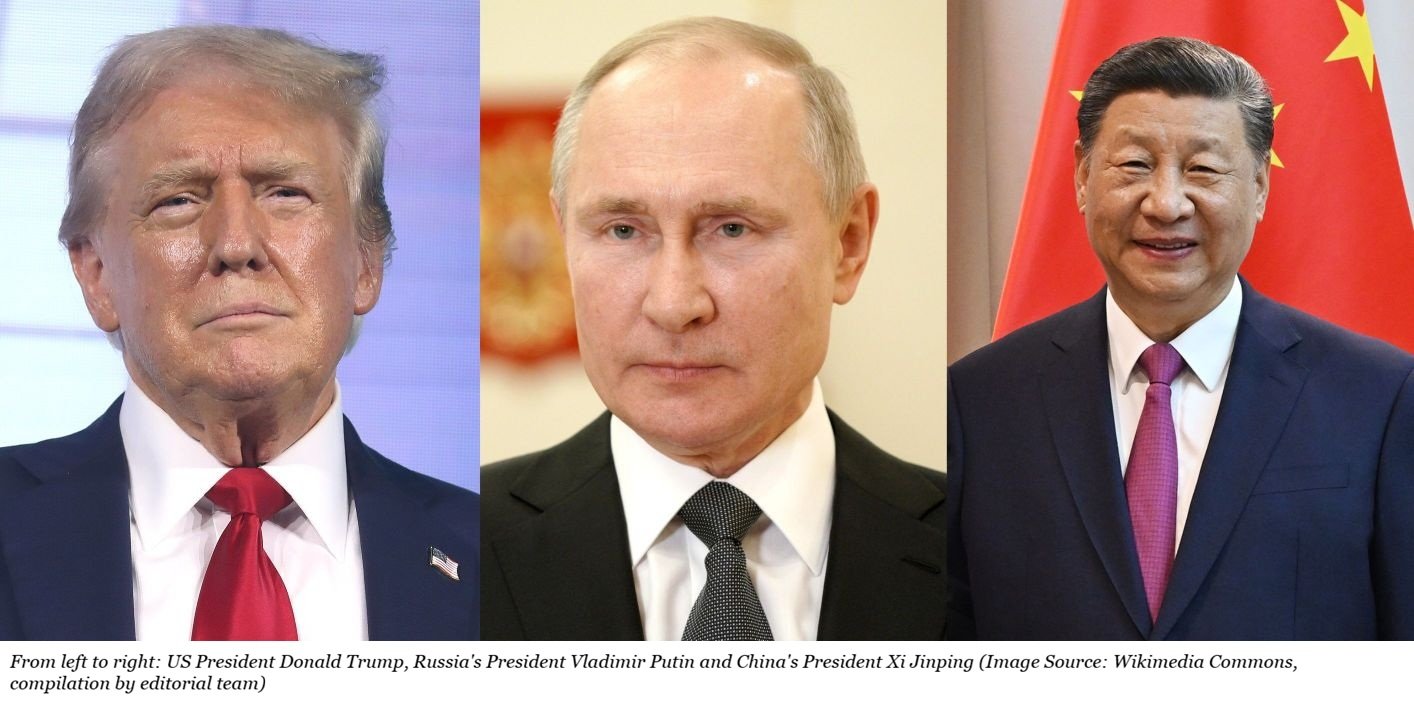
Since the crisis in Venezuela and the sending of elements from the US Navy off the coast of Iran while repression intensifies in Tehran, a question returns in strategic conversations: where are China and Russia? Why this restraint, this low tone, this impression of 'silence' when, in the blocs' imagination, Moscow and Beijing should take center stage, denounce Washington, and show massive support to their partners?
The answer is simple and disturbing: China and Russia are not silent because they are weak; they are silent because they calculate. In these two cases, they prioritize a discreet presence, limited signals: not to pay the price of a confrontation with the United States for causes that are not existential for them.
Partners, Not Allies: The Myth of the 'Camp'
First key: Beijing and Moscow do not operate as a military alliance. China has no intention of 'dying for' Caracas or Tehran. Russia also has no interest in turning Iran or Venezuela into a trigger for a head-on collision with Washington.
It is necessary to distinguish between convergence and guarantee. China and Russia contest American hegemony. They cooperate with Iran on energy, industrial, and sometimes safety aspects. They use Venezuela as an argument against Western interference. But this does not create an automatic obligation. These are opportunistic, reversible, modular partnerships.
In the present moment, the two issues are particularly 'expensive': one concerns the American hemisphere, an area where Washington historically claims a strategic advantage; the other concerns the security of the Gulf, where the United States has a dense military architecture. Under these conditions, Beijing and Moscow make the rational choice: to support without exposing themselves.
The Real Front: Sanctions, Finance, Supply Chains
Second key: the confrontation is not only military. The most durable weapon of Washington remains the ability to structure the cost via sanctions, finance, insurance, access to technologies, and maritime regulation. Beijing knows it: the American power is not only a fleet; it is a system.
Supporting Iran loudly when US military pressure rises, particularly in the context of internal tensions, can set off a chain reaction of concerns, including secondary sanctions, banking issues, rising insurance rates, corporate pressures, and technological limits. For China, whose economy is still heavily dependent on global markets and technologies, the calculation is clear: the political demonstration is not worth the systemic cost.
Russia, already widely sanctioned, is a priori more resilient. But she is obsessed with avoiding an escalation that brings her no gain. She prefers to maintain her posture as an 'indispensable' actor—mediator, supplier, deal maker—rather than being locked into the role of protector obliged by a weakened regime.
Donald Trump Changes The Tempo: Speed, Unpredictability, Transaction
The American president does not invent the balance of power; he changes the way it is used. His diplomacy works like a combination of three tools:
Speed: quick decisions, short sequences, strong signals.
The transaction: everything becomes negotiable, conditional, and exchangeable.
Assumed uncertainty: Unpredictability becomes an instrument
China and Russia excel in another grammar: procedural slowness, endurance, gray areas, and controlled ambiguity. When Washington accelerates and imposes a schedule, Beijing and Moscow lose part of their strategic comfort. Not because they panic, but because the "time" tool—their best ally—becomes less available.
Iran: Discreet Support, Cautious Bet, Emergency Exit
An additional factor weighs on Iran: the internal political risk. When a regime represses hard and appears weakened, associating it too visibly with external support becomes toxic. China does not want to be seen as a protector of repression; Russia does not want to be the prisoner of a losing bet.
Thus, Beijing and Moscow seek a three-tier posture: publicly, call for de-escalation; behind the scenes, maintaining useful channels and exchanges and; strategically, preparation of alternative scenarios, including post-crisis.
It is a policy of maximum flexibility: not to break, not to commit, and not to be trained.
What "Silence" Really Means
The Sino-Russian silence is not an admission of powerlessness. It is an arbitration. It means Iran and Venezuela matter but are not worth a 'hot' cold war. It also means Donald Trump’s America imposes sequences that reduce the room for maneuver of others, and the smartest response, for Beijing and Moscow, is to minimize exposure while retaining the ability to influence.
The conclusion is brutal but realistic: in this world, there are no automatic camps, only hierarchical interests. And faced with an American diplomacy that accelerates and upsets, China and Russia choose the coldest strategy: not to pay the price, let Washington assume the cost, and remain in a position to profit from the next day.
(Gilles Touboul is a geopolitical analyst and former international currency trader with expertise in Middle East and Asia)