


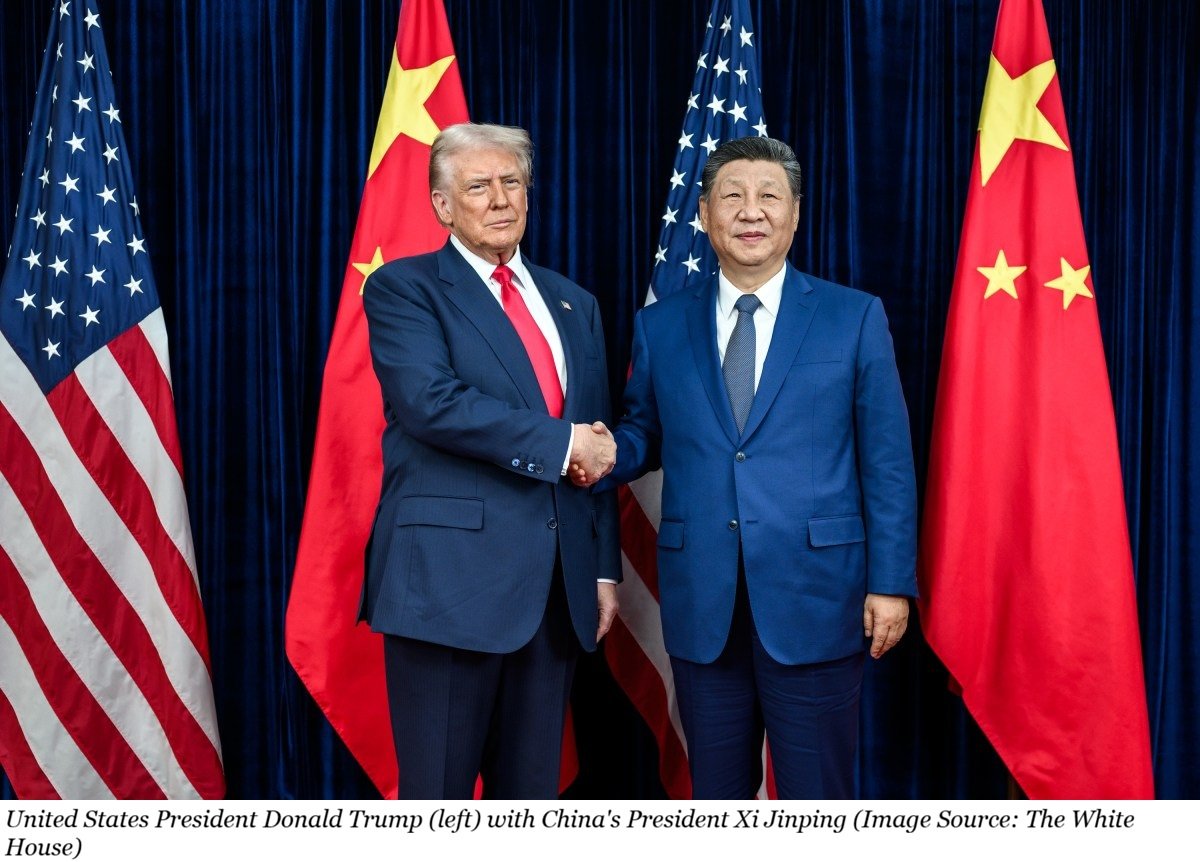
The strategic rivalry between the United States and China has emerged as one of the most significant forces shaping contemporary international relations. In the post–Cold War era, the global system was largely dominated by the United States as the sole superpower. However, China’s rapid economic growth, expanding military capabilities, and growing diplomatic influence have challenged this unipolar structure. Unlike the ideological confrontation of the Cold War, the US–China rivalry is complex, involving deep economic interdependence alongside strategic competition. This rivalry is not only redefining bilateral relations but is also accelerating the transition toward a multipolar world order marked by multiple centres of power.
Historical Background of US–China Relations
After the Cold War, the United States adopted a policy of engagement toward China, believing that economic integration and participation in global institutions would encourage political liberalization and responsible global behaviour. China’s accession to the World Trade Organization (WTO) in 2001 symbolized this phase of cooperation. Over time, China benefited enormously from globalization, emerging as the world’s second-largest economy.
However, as China’s economic and military power expanded, concerns grew in Washington about Beijing’s long-term strategic intentions. The United States began to view China not merely as a partner, but as a potential competitor. This shift became more visible during the late 2000s and 2010s, when China asserted its influence in Asia, expanded its global infrastructure projects, and promoted alternative development and governance models. As a result, US policy gradually moved from engagement to strategic competition.
Economic Competition and Interdependence
Economic relations form the backbone of the US–China rivalry. On one hand, both countries remain deeply interconnected through trade, investment, and global supply chains. On the other hand, economic competition has intensified as both states seek to secure long-term advantages. Trade disputes, tariff wars, and restrictions on foreign investments reflect growing mistrust.
Technology has become a central arena of competition. Leadership in advanced technologies such as artificial intelligence, semiconductors, quantum computing, and digital infrastructure is now seen as essential for economic growth and national security. The United States has imposed export controls and investment restrictions to limit China’s access to critical technologies, while China has invested heavily in domestic innovation to reduce dependence on foreign suppliers. This process has contributed to partial economic decoupling, raising concerns about fragmentation in the global economy.
Military and Strategic Dimensions
The military dimension of US–China rivalry is most visible in the Indo-Pacific Region. The United States maintains a network of alliances and partnerships, including long-standing security commitments with regional allies. China, meanwhile, has undertaken extensive military modernization expanding its naval and missile capabilities and increasing its presence in nearby waters.
Flashpoints such as the South China Sea and the Taiwan Strait highlight the risks associated with this rivalry. Competing territorial claims, freedom of navigation operations, and military exercises have increased tensions. Despite these risks, both countries remain cautious about direct military confrontation. Nuclear deterrence, strategic signalling, and crisis management mechanisms play a crucial role in preventing escalation.
Ideological and Normative Competition
Beyond economics and military power, the US–China rivalry also involves competition over ideas, values, and global norms. The United States promotes a liberal international order based on democracy, human rights, and rule-based governance. China, while participating in global institutions, emphasizes state sovereignty, non-interference, and alternative development models.
This normative competition is particularly evident in global governance institutions, where both powers seek to influence rules, standards, and decision-making processes. Debates over technology governance, internet regulation, development finance, and human rights reflect broader disagreements about the future direction of the international system.
Emergence of a Multipolar World Order
The intensification of US–China rivalry is accelerating the transition from a unipolar to a multipolar world order. While the United States and China remain the two most powerful actors, other states and regional organizations are playing increasingly important roles. The European Union, India, and various middle powers are shaping regional and global outcomes through diplomacy, trade, and strategic partnerships.
Rather than a clear bipolar system, the emerging global order is characterized by fluid alignments and issue-based coalitions. States often cooperate with both the United States and China depending on their interests. This multipolar structure creates opportunities for greater autonomy but also increases uncertainty and complexity in international relations.
Implications for Global Governance and Stability
The US–China rivalry has significant implications for global governance. Competition between the two powers can hinder cooperation on global challenges such as climate change, pandemics, financial stability, and arms control. At the same time, complete disengagement is neither feasible nor desirable, given the interconnected nature of the global system.
Managing this rivalry responsibly requires a balance between competition and cooperation. Confidence-building measures, dialogue mechanisms, and multilateral institutions can help reduce misunderstandings and prevent crises. The ability of the international community to adapt global governance structures to a multipolar reality will be crucial for long-term stability.
Conclusion
The strategic rivalry between the United States and China is reshaping the global order in profound ways. It reflects shifting power balances, technological transformation, and competing visions of international governance. While competition between these two powers is likely to persist, the future world order will not be dominated by a single state. Instead, it will be shaped by a complex interplay of major and middle powers within a multipolar system. Successfully managing US–China rivalry through dialogue, cooperation, and inclusive global institutions will be essential for maintaining international peace and stability in the 21st century.