


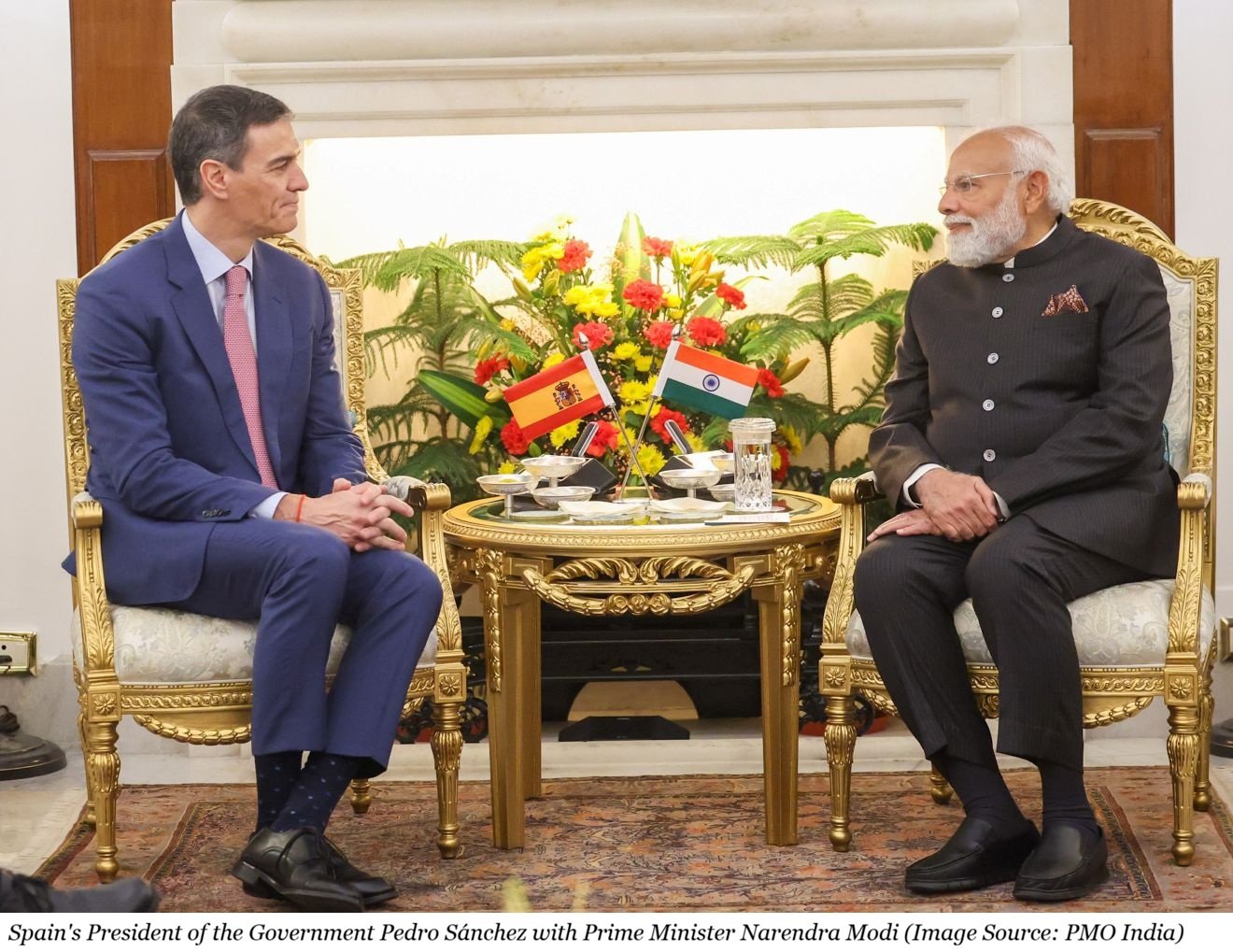
Spain’s President of the Government Pedro Sánchez is visiting India from 18 to 19 February. Sánchez is one of the about 20 world leaders travelling to New Delhi to attend the AI Impact Summit 2026.
Upon landing in New Delhi, Sánchez first held bilateral talks with Prime Minister Narendra Modi. The two leaders discussed ways to boost bilateral ties in the areas of defence, security, technology, and more.
Sánchez is in India at a time when the two sides are completing 70 years of their diplomatic relations. During Sánchez’s previous tour in 2024, New Delhi and Madrid had declared the year 2026 to be the India-Spain Dual Year of Culture, Tourism and Artificial Intelligence (AI).
Apart from timing of the Spanish president’s visit, the frequency factor is also crucial. One of the key factors in development of bilateral relations is that there needs to a consistent interaction at highest levels of political dispensation – between Heads of States and/or Heads of Government. This factor was lacking in India’s ties with Spain for a long time. The meetings between the presidents (or King in case of Spain) and prime ministers of both the countries were characterized by long gaps in between. The two sides are now addressing this inconsistency rapidly.
Sánchez’s visit to India is his second in 15 months. He had previously visited Vadodara, Gujarat in October 2024 to inaugurate the Tata-Airbus C295 manufacturing facility along with Prime Minister Modi. Sánchez is also travelling to India in less than one month since Spain’s Foreign Minister José Manuel Albares arrived in New Delhi for a one-day visit in January. With this visit, Sánchez becomes the first-ever Spain’s president of the government to tour India twice. Further, the Spanish leader is coming to New Delhi close on the heels of European Union’s (EU) top leadership’s visit to India in January to conclude a free trade agreement with India. The increasing and accelerating engagements at the highest levels of political dispensations of both the countries is a very encouraging development.
Sánchez’s New Delhi visit is concomitant to Spain’s special focus on Asia. In its attempts to widen foreign policy engagements, Madrid has been channelling its focus on Asia through institutionalization of various foreign policy strategies. As a guidance for these interactions Spain has formulated various strategy documents in the past about one decade. These documents included A Strategic Vision for Spain in Asia 2018-2022 and Foreign Action Strategy 2021-2024. Recently Madrid came out with Spain’s Foreign Action Strategy 2025-2028 that outlines the importance of India as one of Spain’s close partners in Asia as well as on the global stage.
The partnership between New Delhi and Madrid, already on an upward trajectory can further diversify. With Sánchez attending the AI Impact Summit, a technology event, India and Spain are now looking forward to consolidate their ties in the information technology sector.
This current engagement between India and Spain assumes greater importance as the two countries are expanding their cooperation in the defence sector. With AI becoming an integral part of defence and security, the scope for wider cooperation between India and Spain in the IT field becomes imperative. In particular, countering misinformation and disinformation, much of which is generated through AI, is an area where the two sides should look to work together. Further, India and Spain have a shared vision on multilateral global order. AI and IT provide a major avenue for the two countries to work towards the regulation aspect and prevention of misuse of technology.
Another aspect of Sánchez’s visit is that Spain should look forward to engage more with India on bilateral basis. India enjoys strong ties with the EU. However New Delhi’s ties across the EU are not even. For its part Spain too prefers aligning its foreign policy with the EU or to engage with partners through the EU. However, greater proximity between India and Spain would not only strengthen their bilateral ties but also consolidate their respective engagements with the EU.
India and Spain have always enjoyed strong soft power relations in the fields of language, literature, art, culture, tourism, and music. However, despite regular exchanges in these areas, the bilateral ties had remained in an emerging stage. The principal reason being the strong soft power ties were not complemented with growth in hard power engagements. However, the two countries have now expanded and diversified their relations in the areas of defence, technology, and clean energy. All these are strategic fields in which partnerships become crucial to navigate through a turbulent global order.
Sánchez’s visit to India definitely provides a boost to the already accelerating India-Spain relations.
(Niranjan Marjani is the Editor-in-Chief of Global Horizons. Follow him on X: @NiranjanMarjani)