


India is the world’s fastest-growing economy, with growth of 6.4 per cent in 2025 and 2026, according to the IMF. Recognizing the importance of trade in creating jobs and rapidly boosting its economy, New Delhi has signed two very critical trade agreements since the beginning of 2026. These recent agreements signal a clear direction in India's broader trade policy approach.
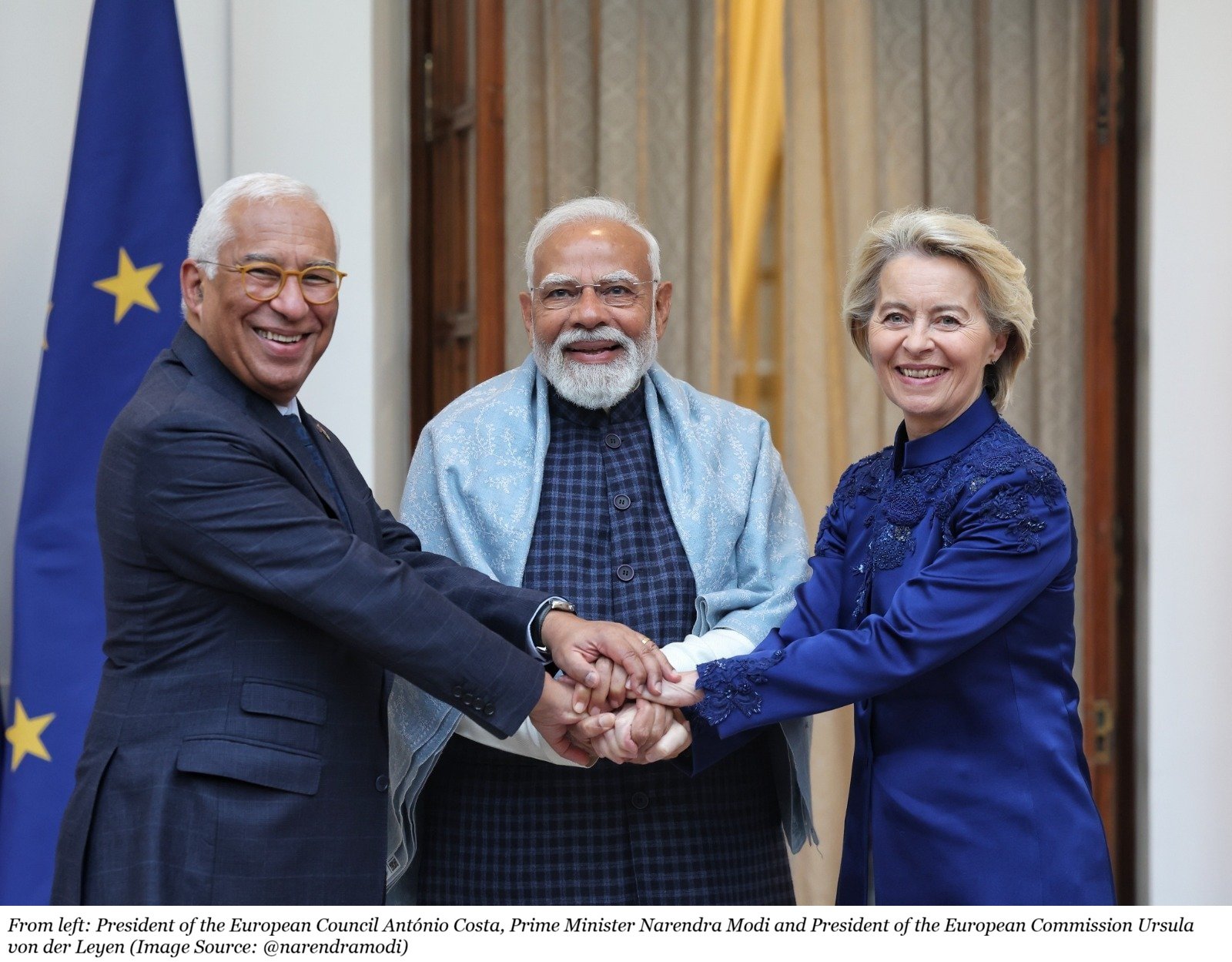
The India-U.S. Trade Agreement on 02 February 2026 and the India-EU Free Trade Agreement (FTA) on 27 of January 2026, also called the 'mother of all trade deals,' illustrate this momentum. Notably, the recent India-U.S. trade deal would bring the total count of FTA’s signed between 2021 and 2026 to nine, underscoring the ongoing shift in India's trade priorities.
This evolution represents a strategic shift in India's foreign policy and trade negotiations since 2014. What prompted this change? Why did India refrain from signing agreements between 2014 and 2021, and what has since shifted?
India signed only 13 free trade agreements until 2021, while it did not sign any agreements from 2014 to 2021. From the 1990s to 2021, India predominantly signed agreements with countries in East and South Asia, including Sri Lanka, the SAFTA, Thailand, Singapore, South Korea, Japan, and Malaysia. This has been anchored with the government's mandate of the ‘Look East’ policy.
However, since 2021, India’s focus has shifted to signing agreements primarily with the 'West.' This evolution did not occur overnight but stemmed from significant political changes in 2014, when the Bharatiya Janata Party (BJP) secured a clear majority, defeating the Indian National Congress (INC).
Against this new political backdrop, the BJP-led government became more cautious after 2014, pausing FTA negotiations amid rising apprehensions. This was especially evident after trade deficits with ASEAN grew to 9.66 (USD) billion in 2016-2017, according to the Ministry of Commerce and Industry.
Amid this reassessment, India gravitated toward what negotiation theorists call ‘Principled Negotiations,’ or interest-based bargaining. This approach, popularised by Roger Fisher and William Ury, rests on four core ideas.
First, negotiators should focus on underlying interests rather than holding rigid positions. Second, generate multiple options for mutual gain instead of treating negotiations as a zero-sum game. Third, rely on objective criteria and rules to evaluate proposals. And lastly, separate people from the problem, as India and the EU agreed not to include agriculture in the recent FTA.
This shift has been visible in the new FTAs with the UAE and Australia. The negotiation approach has been more calibrated, with faster timelines and focused tariff concessions. India has now emerged as a creator of bespoke packages that help maximize mutual gains while accounting for domestic political economy constraints.
The recently concluded India-EU FTA on 27 January 2026 is a testament to the application of principled negotiation strategies. After almost two decades of negotiations, the Indian and EU negotiators embraced the principles of principled negotiation through an early-harvest agreement.
Their insistence on addressing chapters one by one, rather than taking a take-it-or-leave-it approach, helped conclude the negotiations. This indicated that both sides, the negotiators, wanted to generate options for mutual gain rather than just accept the binary choice between a comprehensive agreement and failure.
However, adopting principled negotiation has not involved abandoning strategic economic considerations. On the contrary, the new FTAs are designed to embed flexibility, reflecting India's broader maturity in economic statecraft.
New Delhi has signed nine agreements, reflecting a shift from positional bargaining to interest-based problem-solving. However, businesses and enterprises face a challenge in fully leveraging these FTAs and making them an instrument of economic prosperity and strategic autonomy.
Therefore, India’s adoption of principled negotiation strategies in the recent FTAs marks a critical shift in trade negotiations since 2021. However, the true test now lies in translating these agreements into tangible gains for businesses trickling down to the country’s economy.
Going forward, India's approach to free trade agreements is poised to prioritize innovation and sustainability in trade as the country aims to achieve net-zero emissions by 2070. New Delhi can position itself as a leader in shaping the rules of international trade while ensuring its economic growth is both inclusive and resilient.
(Ambassador Latha Reddy is the Founding Partner at the Hoodi Strategy group and former Deputy NSA and Secretary East, MEA. Follow her on X: @lathareddy51; Ashwin Dhanabalan is a Konrad Adenauer Stiftung Scholar at Christ University. Follow him on X: @AshDhanabalan)