


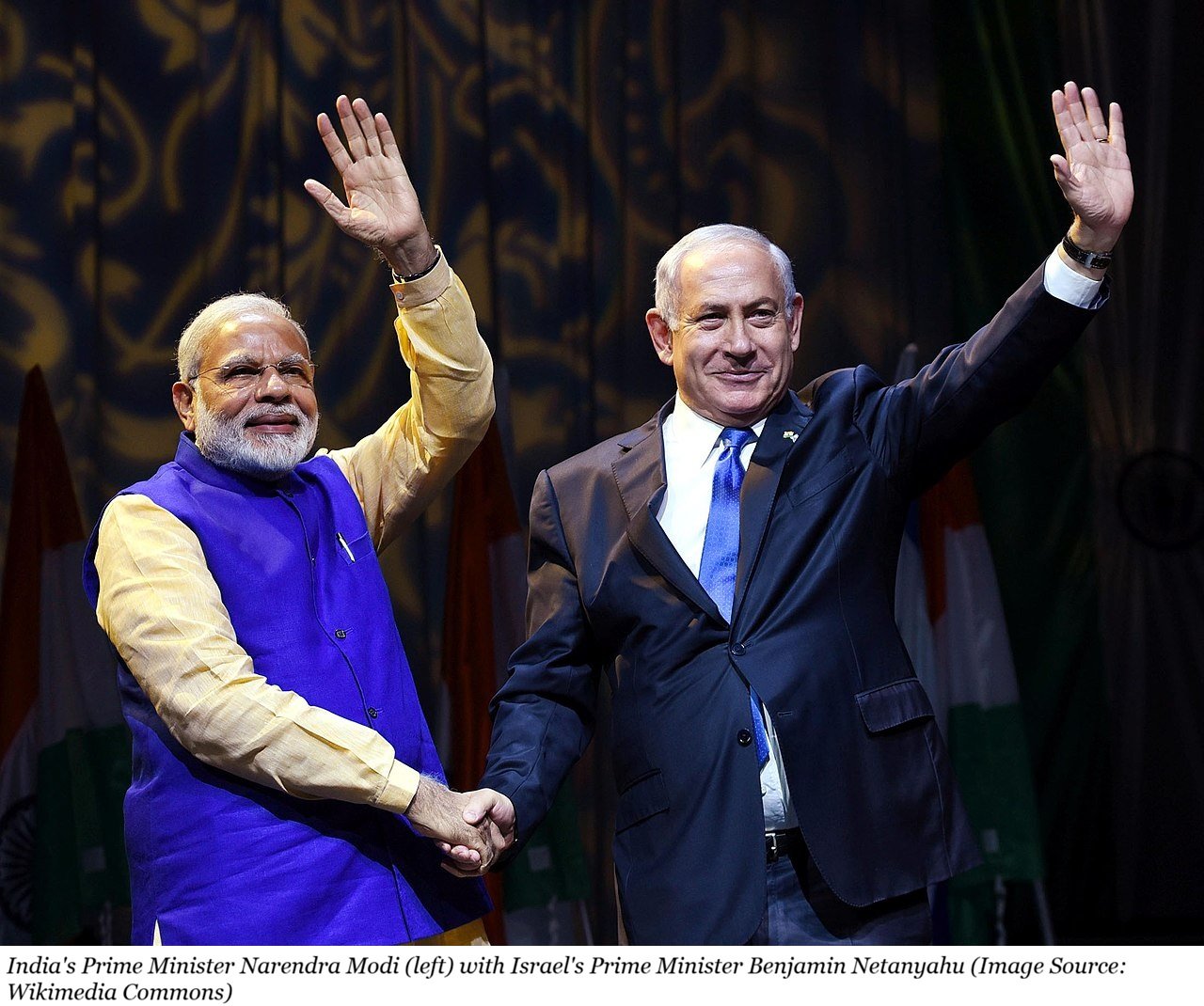
A big military contract with Israel and Prime Minister Narendra Modi’s expected visit to Israel at the end of February 2026 are not just news items. Put together, they look like a diplomatic statement: India wants to be seen as more than a customer or a distant observer in the Middle East. It wants to be a serious actor with interests, partners, and influence—without joining anyone’s camp.
India has been managing the region for years by striking a careful balance between its growing but often covert security relationship with Israel, its strong ties with the Gulf for jobs and energy, and its practical approach to Iran when it suited Indian interests. Not only is the content changing now, but so is the visibility. A high-profile visit and a sizable defense deal demonstrate that India is at ease displaying the relationship in public and using it to convey a more comprehensive strategic stance.
Defence Deals as Strategic Autonomy, Not Alignment
India’s cooperation with Israel is usually described as "defense trade,” but that label is too narrow. Israel offers what India values most in the current security environment: fast delivery, proven systems, and technologies that upgrade real battlefield performance.
The deeper logic is strategic autonomy. India has spent years diversifying suppliers so it is never trapped by a single partner’s politics. Israel fits that approach: a technologically advanced partner with a record of operational innovation and a willingness to work through joint production and technology transfer when the political conditions are right. A large contract—especially if linked to “Make in India” manufacturing—also supports India’s domestic political narrative: strength abroad and jobs at home.
A Message to China, Pakistan, and the Middle East
Every defense partnership has an audience beyond the two signatories. India’s upgrade with Israel speaks to three audiences at once.
First, China. India faces long-term pressure along the Himalayan frontier and in the Indian Ocean. Stronger intelligence, surveillance, precision, and air defense capabilities improve deterrence without requiring India to sign formal military blocs. In a world of sharper competition, India wants a toolbox that makes it harder to coerce.
Second, Pakistan. The message is familiar but still important: India will continue to modernize and deepen high-end partnerships. Israeli technology has long been part of that modernization story. A large new package reinforces it.
Third, the Middle East itself—especially the Gulf. India has Indian citizens working in Gulf states, depends on Gulf energy, and invests heavily in Gulf trade and infrastructure. New Delhi wants the Gulf to read the India–Israel track not as a provocation but as proof that India can manage multiple relationships at once. The Indian pitch is, "We can be close to Israel and still be a reliable Gulf partner.” it is exactly the kind of balancing India is now trying to master.
The “Connector Power” Play: Security Meets Corridors
India’s interest in the region is not only military. It is also about routes, ports, data, and trade. Recently, India has promoted the idea that it can connect the Mediterranean, the Gulf, and South Asia through new economic corridors and infrastructure partnerships. In that context, Israel is not only a defense partner; it is also a geographic and commercial link to the Mediterranean and Europe.
This is where India’s “renewal” in the region becomes clearer. India is trying to move from a narrow West Asia policy—energy imports, diaspora protection, occasional crisis management—to a broader one: building economic architecture. The message conveys India's desire to participate in the design of regional connectivity. It wants to shape trade routes, not only use them.
The Risks: Polarization, Iran, and Domestic Politics
A more public India–Israel relationship also carries costs. The Middle East is a region where symbols matter. In a period of intense emotions around Gaza and wider regional tensions, India must manage the optics of being considered too close to one side. That could complicate India’s messaging in Arab capitals and among wider public opinion.
There is also Iran. India’s relationship with Tehran has fluctuated, but India has historically avoided turning Iran into a permanent enemy. A sharp deepening with Israel, especially if perceived as part of a broader anti-Iran front, could narrow India’s room for maneuver. India may not want to choose, but regional dynamics can force choices indirectly. Finally, domestic politics plays a role. High-profile foreign visits and major defense deals always invite debate at home: transparency, priorities, and what India gains in return. The government will likely present the package as proof of India’s rise—stronger defense, stronger diplomacy, and stronger global standing.
In the end, the meaning of Prime Minister Modi’s Israel visit and a major defense contract is not only bilateral. It is strategic with real content. India is showing a renewed ambition in the Middle East: to be a security partner, an economic connector, and a power that can balance relationships. Whether the region allows that vision to succeed will depend on one thing India cannot fully control—how polarized the Middle East becomes in 2026.
(Gilles Touboul is a geopolitical analyst and former international currency trader with expertise in Middle East and Asia)